Subscribe:



Starting a new graduate and hoping they’ll “figure it out” as they go?
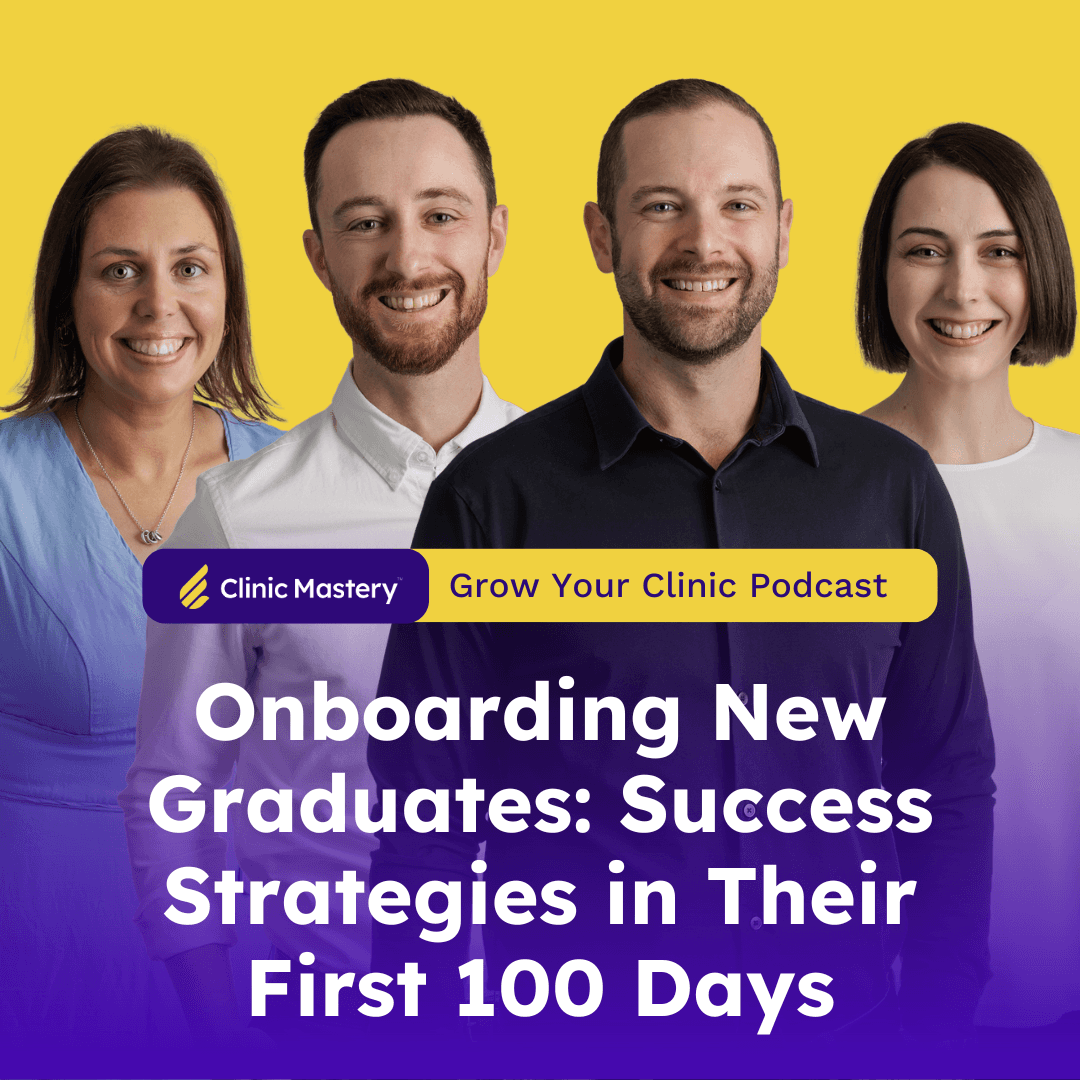
In this episode of the Grow Your Clinic podcast, we break down how to onboard new grads in a way that builds confidence fast and sets them up for long-term success. We unpack why early familiarity matters, how purposeful shadowing and getting reps in early accelerates competence, and how clear expectations and clinic culture reduce overwhelm. We introduce the three-stream onboarding framework—personal, professional and practice—and share practical ways to use early involvement, feedback and flipped learning to create smoother transitions and stronger clinicians.
If you want new graduates to feel confident, capable and connected from day one (not six months in), this episode gives you a clear, practical onboarding playbook.
Need to systemise your clinic? Start your free trial of Allie! https://www.allieclinics.com/
In This Episode You'll Learn:
🌟 The essentials of onboarding new graduates in your clinic
👩⚕️ How to help new grads build confidence and capability
📅 The significance of the first 100 days for new team members
📚 Effective strategies for shadowing and co-consulting
🎉 Celebrating milestones to boost morale and engagement
💬 The role of personal connection in team culture
📝 Tips for documenting training to streamline future onboarding
🤖 Leveraging AI for feedback and self-reflection
Timestamps:
00:00:00 Episode Start
00:04:32 Collective language in team culture.
00:08:18 Onboarding new graduates effectively.
00:12:10 Slipstream assimilation for new members.
00:17:30 Celebrating new grad milestones.
00:19:54 Three streams of onboarding.
00:22:50 Patient co-consultation strategies.
00:30:01 Ideal client identification process.
00:38:14 AI in new grad onboarding.
00:40:45 Feedback loop and self-reflection.
00:47:22 Effective feedback in leadership.
00:49:04 New graduate support strategies.
Discover more episodes!















Episode Transcript:
Jack O'Brien: Well, well, well, listeners, let it be known that Bec and I were on time and Ben doesn't know whether it's Tuesday, Thursday, or Christmas.
Ben Lynch: That's true of any day, I think. Not just now. The trolling in our Slack channel is fantastic. The GIFs, the emojis.
Jack O'Brien: The volume of GIFs in a clinic's communication platform is a lead indicator of culture. I like it. Click that for the reels.
Ben Lynch: G'day good people. Welcome to the Grow Your Clinic podcast by Clinic Mastery. Here's what's coming up inside of this episode. When you think about new grads who struggle early versus the ones that really find their feet, what do you usually see that's missing from their onboarding?
Jack O'Brien: And what are the best doing? They're making sure that their new grads are seeing patients definitely in the first week, probably the first day.
Bec Clare: If you have felt like you've ever said something in training more than once, then document it. And rather than feeling like you've got to create a resource, document. Document versus create.
Jack O'Brien: Come join us over on the YouTubes, get a peek behind the Physio West curtain.
Ben Lynch: That was a little bit more ranty. I was sort of challenging my energy to be there. But anyway.
Jack O'Brien: Look, I'm a bit ranty, so forgive me. I try to have a two minute bell in my mind of like, stop talking, two minutes.
Ben Lynch: My sleep score last night was 94. Just saying. 99? 99! This episode will be right up your Allie if you're looking to onboard a new graduate. We're diving into their first 100 days at your clinic and trust me you'll want to hear Bec's take on how the personal onboarding is the third essential piece that's often missing for new grads. Plus stick around for when Jack drops his essential onboarding checklist. Before we dive in, today's episode is brought to you by AllieClinics.com. If you're the kind of clinic owner who loves to feel organized and stay ahead of the chaos, you'll love Allie. Think of it as your digital clone. It's the single source of truth for all your clinic's policies, systems, and training. Test it for free at AllieClinics.com. And in other news, applications are now open to work with us one-on-one at Clinic Mastery. If you want support to grow your clinic and bring your vision to life, just email hallowettclinicmastery.com with the subject line podcast and we'll line up a time to chat. All right, let's get into the episode.
Jack O'Brien: I mean, here it is. I'm actually going to see if I can share my screen here because I think this is important. When we talk culture, these things matter. And so here it is. According to Sarah at 11 Lights Media, the cringe emojis for Gen Alpha is the laughing emoji Who knew? The sunglasses, the devil, the ghost, the crying cat. Fair enough. But society accepts the, I don't know what you call that, the sunken rose. Is it a rose? Yep. The skull, the stars, the lipstick, the nail polish. That's fair enough. The salute. I love a good salute emoji.
Ben Lynch: I'm noticing the salute getting around the CN grounds a lot more recently. It feels weird. I don't know. It's very military. That's why you love it.
Jack O'Brien: It's like, yes, sir. When it's a yes or no question, it's very affirmative. Okay. All right.
Ben Lynch: There you go, Ben.
Bec Clare: All right.
Ben Lynch: Okay. I got to clearly change up my game.
Bec Clare: I think my repertoire is- You can't just be thanking Jack. You've got to be saluting him.
Ben Lynch: Most of those emojis you've shown, I've never seen before. I think my repertoire is about three to five. But it seems to work.
Jack O'Brien: If you're a clinic owner and you're recruiting someone who's a Gen Z, Gen Alpha, maybe this is the secret source for 2026 is your emoji game. Yes, I like it.
Bec Clare: We pre-frame it as part of induction. Get ready for the emoji game.
Jack O'Brien: Oh, I saw that in your doc a few episodes ago, actually. Yes.
Bec Clare: We talk about it. It's quite overwhelming. People are like, am I meant to react? How do I react? What am I meant to say?
Jack O'Brien: I think you're onto something, Bec, because there's something, and I don't know who would say it, maybe let's say Simon Sinek, probably, but someone else. This notion of collective language and jargon on the inside is something that really galvanizes a team. You think about it in our clinic mastery context, we talk about team, not staff. Yeah, and it's all these different language things that we all know is how we speak around here. It says a lot about who we are as people. And so, yeah, I think there's a lot to be said for having that as part of your onboarding, Bec.
Bec Clare: Allow people to feel welcome, that they know how to speak the language, that they're already starting to practice it. So we invite our new team members to come on board with Slack way before they start with us. Just a couple of channels, don't want to overwhelm them with all of the channels. just a couple, um, just so that they can start to be part of the culture before they arrive on day one. And then they just start to see some of the language and we provide them with a little one page sort of dictionary, if you like, of the Physio West language. And it highlights things like staff versus team, um, investment versus pay for, just the subtle things that actually, when we hear the alternative in the corridor, it almost like makes the hair stand on the back of your neck. me like, oh, what is that word? So we want to make sure that they feel happy, comfortable.
Jack O'Brien: And the thing is, most clinics would have a collective language around what they do. Maybe they just haven't codified that yet or written it down. I know for us as Clinic Mastery now, behind the brand, which is a resource template that we have for clinic owners inside our learning portal, but for our business, we have a whole page in there dedicated to, we say this, not that. It's clients, not patients. It's team, not staff. We bring the energy, we don't have fun. That's a joke. But there's a whole page of this language, which is really interesting.
Ben Lynch: Yes. What it means to be part of CM and a CM-type clinic as well, very values-driven, we believe at least. I'm sure plenty of folks disagree and we're not for them, but that's okay. There's plenty of folks that do like being super intentional and purposeful about how they support their teams and create amazing experiences for them and their clients. It's the sort of folk that we love working with as well. I had a great conversation with Sarah from the people plugin this morning. We were just talking about standards. We've got a video going into the community in a couple of days time. And it comes back to that right from the beginning. And today's conversation is around onboarding new team members. perhaps one of the best possible opportunities to reset or start to reframe your culture from someone who's coming in, they're kind of fresh, they're a blank canvas. So, let's tee this up specifically because, Bec, you put this on the docket, and I'm going to throw to you in a moment, but to set the context I think new graduates, they don't start their role particularly worried about reaching the number of appointments or service hours that they need to hit to break even in their role. They're worried about doing harm to patients or running late or looking unsure or letting patients down in their care. But for the clinic owners, they're worried about the road to profitability. How long will it take for us to support their wage? They're thinking time, money, risk, if I made the right choice. And I think most onboarding fails, or at least falls short, not because you don't care about these team members, but it's because you're onboarding new graduates like you onboard experienced clinicians, and they're not the same. So today we're going to talk about what actually changes when you're on board and you graduate properly. What are those first 12 weeks or first hundred days about that need to look like to build the confidence, the capability. and importantly, the momentum without burning out the owner or the clinician in the process. So Bec, my question to you to kick us off is when you think about new grads who struggle early versus the ones that really find their feet, what do you usually see that's missing from their onboarding?
Bec Clare: I'd say familiarity. And what I'm looking for from a grad is, from the point at which they finish their studies to getting their APRA and then to all of the other processes and things that have to happen after that, which is your Medicare provider number, there's generally somewhere between, I'm going to say 6 to 12 weeks of time and space. And what we like to see from our grads is that they're getting into the clinic, they're jumping in with either our senior clinicians or our emerging leaders and shadowing consults with specificity. When we say to them, so in your first week of shadowing, we'd love for you to take specific notice of how Ben closes out the last five minutes of his consult. Love that. How does Jack welcome a client? All of the little incidentals, mostly around communication. We're wanting them to focus solely on how they communicate, how they get the treatment plan out of here and here that makes sense and that a client is happy to buy into. So we're doing that before they even start. So, DayDot, they're also then familiar with the surroundings of the clinic, where to find resources and stock, how to interact with the client care team. They're just more grounded before day one, because you've got time. And I think the clinics that I see do this really well, they utilize that time.
Ben Lynch: It's a great point about getting them into the fold. Hannah spoke about this, Jack, on a previous episode as well. Sort of getting them to shadow early and often, if we can. Being able to do that though with the Purpose Bec is a really smart way to do it rather than just, you know, throw them into the consult, hey, can you shadow Ben or Jack or Bec or whoever during the day. Actually setting the intention, I want you to focus on these couple of things and I want you to take notes and we're even going to report back on how that looks. I think so much of this centers around running consults. And running consults back to back while staying on time and getting your notes done in a way that feels in flow, easy to sort of reverse of that is that you're not overwhelmed or you don't feel stuck. J.O.B., you've done a lot. I mean, super passionate about new graduates, early career professionals. What are some of the things that you see are missing from those that really do hit their strides as a new graduate as distinct from those that maybe feel overwhelmed and get a less than ideal start?
Jack O'Brien: Yeah, there's two things I'd speak to. First, I'd love to continue that and echo that from Bec around involving people, including them in the fold. share my screen here. We had Joey Coleman on the podcast a couple of times, but wrote an amazing book, Never Lose an Employee Again. And one of the things that Joey said on that episode that really stuck with me is this, when we feel that there is someone at work who personally cares about us, who is invested in our success, we do better. And he speaks here about the difference between co-workers and colleagues. And so I think it's a really important distinction that we quickly assimilate and make sure that our new team members feel like part of the furniture. And so whether that's, you know, when it comes to shadowing, whether that's shared experiences, whether that's personal touch points around gifts, but I think that's a really key one. I'd love to speak to another concept, but Bec, you've got any comments or feedback on that?
Bec Clare: I do. You've eloquently put it in Joey Coleman's language, and I love that resource. For all of the parents out there, the analogy that I use around assimilation is thinking about finding Nemo when they're in the slipstream and all the turtles are flowing along and everyone's in there and other fish flip into that slipstream. Your new team member should feel like, oh, hey, you're here versus, oh, who are you? And we actually talk about that with the team. We've got a younger team, so they've all grown up watching things like Finding Nemo. So we actually say to the team, how can we help them feel like they've slipped into the slipstream and they've felt like they've always been here?
Jack O'Brien: I really like that and so often we think about personalizing the first day, the first week for a new team member but there's something to be said for clinics that do a version of this. Creating a little baseball card kind of profile of the new team member and giving that to your existing team. With those little personal touches, do you know the name of their partner, their spouse, their kids? Do we know the name of their dog, their coffee order if you're going to go out for a coffee? So that when new team member walks in, existing team member says, oh, welcome, so excited to have you, you know, your partner and your kids are part of the physio family or whatever the case is. So yeah, how can we include them in that slipstream?
Ben Lynch: Hannah spoke of belonging, just to add to that as well, like making them feel like they belong before they even start to cut you off, Joby, which I'm really good at.
Jack O'Brien: Yeah, great. Keep going. The other distinction I'd make for onboarding new team members is around getting the reps in. And so we don't want to solely focus on reading and shadowing and feeling nice and fuzzy, particularly for new grads. getting the reps in as quickly and sustainably as possible is super important. And I know we did a mastermind on this with our coaches, a quick round table brainstorm, which we do with our dozen plus coaches who are also active clinic owners. They are the best of the best, cream of the crop. And what are the best doing? They're making sure that their new grads are seeing patients definitely in the first week, probably the first day, with really strong supports around that, both personally and professionally. But let's practice. Let's put into practice what we are learning by getting the reps in with patients. It's a bit controversial, right? No, no.
Ben Lynch: It's a great point. I think maybe even Hannah had mentioned that – if it was Hannah, otherwise I'll blame Hannah – that she had made this expectation, this standard, oh, we're going to ease you into it over sort of six or eight weeks and realized, ugh, this created a whole bunch of problems on the back end of people when we did try and ramp them up going, I feel overwhelmed, I'm burnt out. And going, no, actually, we want you to get in there sooner. That great saying of competence breeds confidence. And that's one of the key issues with a new graduate is they don't feel confident. They're just coming out of uni and they're wondering, there's still that cognitive load of the assessment, the diagnosis, the plan. Is this the right thing? Should I prescribe? Should I rebook? I'm not sure what's going on. So being able to get in there, JB, I think is a terrific plan to do that. earlier. You can still ramp up, but start earlier and maybe add some weight, so to speak, and build up quicker to the utilization number ultimately that you want to be hitting.
Jack O'Brien: I agree. I recall that brainstorm, that conversation that we had with the coach was around if we want to get a new team member to break even on their wage, which is roughly 15 appointments depending on how you slice and dice it, would we rather a new team member see three appointments a day for five days or would we rather them see eight appointments a day across two days? And the distinction of the consensus across our Clinic Mastery coaching team was let's get our new grads seeing eight patients a day as quickly as possible. Because the learning from our team was when they only see three patients a day across five days, well, four patients a day feels like burnout territory. How can we help them see that eight patients a day, and I say eight, that's going to look different if you're an NDIS speech psych OT. Maybe it's six sessions a day. If you're an MSK, it looks more like 10 a day. But how can we see a full day's worth of clients? That won't happen every day. We might space it out across Monday, Wednesday, Friday, and then four days. But get comfortable that you are able to do this and get the reps in. Bec, what's your take on that?
Bec Clare: It definitely creates better flow, in my opinion. They start to get into flow. They also have already seen that in their shadow sessions before they start. So we're wanting them to be shadowing a high-performing clinician who is going back to back so that they know that this is quite normal and they see the swan on the surface. as well and they see someone who's got their systems in order so they know that, oh, I can do this. I've got the right support. Absolutely. We're wanting our new grads to be seeing clients as quickly as possible so that we want to also celebrate that moment. So we have a process or a patterning clinic where once our new grads have seen their first patient, we sort of bring them back into the team room and there's a couple of us in there going high five. You've got to remember, this is their first ever client. That doesn't ever happen again in their career. So we take that moment and we really celebrate it and we're like, right, you've ripped the Band-Aid, let's go. So we're out really celebrating that moment and having it as quickly as possible into their first day or week. I love that.
Jack O'Brien: I'm thinking here, this is what I'd be doing if I'm onboarding a new grad next year. I'd be thinking about how can I gamify or classify a new grad? I'm thinking about a belt system. White belt, you've seen your first console. Whatever the next colour is, I don't know, karate or jujitsu.
Ben Lynch: A different metaphor.
Jack O'Brien: That's where the analogy falls short. That's the end of my story. You've seen 10 patients in a week, next belt. You've seen a full day's worth of clients. You've seen 10 patients in a day, next belt. You've reached full capacity or you've hit a full week, 50 appointments, next belt. What a celebration moment. That's awesome, Bear. It's a great point.
Ben Lynch: What you're speaking to, JOB, is essentially what are the outcomes or milestones that we want to achieve in your onboarding process? I think we can all get very task orientated, literally induction to the space where parking is and all those things need to be covered, how you submit leave, da, da, da, da. coming back to what are some of the key outcomes that we're working towards and we want to celebrate is a really great way for folks to break down how to do their onboarding. I think a lot of clinic owners have some version of a first week, maybe a first two weeks. What we're really looking at here is an extended We love 100 days. It typically gives you enough time for repetition, which is also a key mistake that a lot of people make. They do something once and they go, well, they know it now and it's just about repetition. How about we revisit? Show me how good you are at doing this. What have you learned? What have you implemented? So I think repetition is key. That's why we do 100 days. The other element to this, I see clinic owners do two out of three things really well, and they overlook this important element of onboarding, and it's around the personal. Joey Coleman spoke about the personal side. We do this in three streams, we call it. So the personal, the professional, and the practice. The professional side of things is the clinician's caseload, how they run appointments, help them with clinical diagnosis, therapy resources, et cetera. The practice side is understanding the origin story, the vision, mission, values, meeting the partnership network, knowing how we do marketing here, how they play their role in the broader community, et cetera. The personal side, we've spoken about this a number of different times around their desire statement, their personal goals, their career pathway moving forward. It's understanding some of their preferences in communication style, management style. Perhaps you use some personality profiling to help understand how they work best as part of a team. It's really understanding the human. You spoke to some of those things, Jack, of like, who's part of your family? What do you do outside of work? building the baseball card version. So just to capture this and help people understand the three different buckets, I think most clinic owners do two of three well, but it's that third bucket that actually is perhaps the real missing piece that when we understand that, we can have the harder conversations when we have to have them or the tricky conversations around performance or overwhelm or feeling burnt out by understanding the person that we're working with. So I think that's a really good distinction that you made. Bec, how else do you navigate and nuance it to a new grad as distinct from the experienced clinician?
Bec Clare: What we've learned over the journey is there's not a lot of nuance. Ultimately, we want to set a team member up for success. And so a lot of that, particularly all the personal mastery stuff, we do that for every team member, irrespective of their role. That's so important. Whether that be an admin team or a team member or a leader or finance, whoever's coming on board the team, that happens. I guess probably the distinction between a new grad to a senior clinician is that shadow aspect. There's a little bit less of that. And we probably switch that out for some co-consulting in their first week. So versus it being shadowing where they sit in on a consult, we have a senior team member co-consult and they jointly run those consults together. So we're having a little bit more of a look at, we're in masks, so a little bit more of their hands. How are they prescribing exercises? How are they rounding out the consult? What are they testing? So we're really wanting to sort of switch up how we do it. subtle distinction, but it works.
Ben Lynch: How do you frame that to the patient? Do you use some scripts or some framing? Do they know ahead of time? Is it revealed on the day? Just talk us through also some of the mechanics of getting the quote buy-in from the patient to enable that to happen as well.
Bec Clare: The senior therapist who's ultimately having another therapist come into their session is, they're very well aware, or at least they should be, of their clients and their preferences. So if there's anyone that's a little bit sensitive or it's a sensitive condition or they're going through something a bit challenging, then we wouldn't offer a co-consult. In terms of how we frame it, it happens on the day, in the moment. The clinician will take the client through and say, look, hey, I've just got my colleague, Ben, joining me in the consult today. Hey, you get two for the price of one. How great is that? Yes. It's really hard. Often I think we're very robotic about it.
Ben Lynch: Okay, that's really good. There is certainly some value there. Some other things, and I take your point around maybe it's pretty much the same depending on the years of experience and I think that speaks more to we set the standards and whether you're coming in with years of experience, you've also got a bias from the previous clinics or workspaces that you've had that we want to make you a physio west physician. physio or insert your profession. We want you to treat and work and operate like us. So, that makes a lot of sense. There's a couple of elements here to the training that I would love to unpack as to what you emphasize in those early days, like some of the content. And also, for those clinic owners, there's maybe a couple of different avatars that we would hear and see, a couple of different clinic owners at different stages. There's the one that's like, I'm just super busy. Maybe this is the first team member or the next team member. My caseload is quite big and I need to kind of do this on the fly. I don't have a lot of time to build this out. And then there's the clinic owner that, well, I've got time to do it, but I'm not sure where to start. So help me unpack what are some of the lessons that you've learned and things that work. And then maybe you've got the clinic owner that, hey, we've got a zero to 100 or whatever you call it, an onboarding system. It works all right, but we're always looking for the next level. How can we refine this or improve it? Maybe it doesn't get used particularly well, but it's there. So I think wherever you're at, there's a couple of key things that we're looking to do is how do we help the team member that's just joined us take more ownership of their onboarding rather than rely on someone else. I think they can play an accountability and support role. One thing that helps do that is the flipped learning or the flipped classroom model that we've referred to before, which is in a classroom in some schools, they run this model where for homework, you actually learn the lesson. So you watch a video typically. So you learn the theory, the methodology and the practice. And then in class, it's time for application. So you can learn on the job and refine. That can work in the clinic as well. Are there videos maybe that we've taken from the wider web and pulled into our hub like A11y as an example, they can watch and consume the learning. And then our mentoring face-to-face time, which is precious for a lot of clinic owners, is about application or workshopping. We don't want to learn things for the first time. That can be done independently. So just for that clinic owner that's a bit stretched for time, that's a really effective methodology for putting it back on the team member and making them feel like they're driving things. Jad, I know you've done this work. What else have you got?
Jack O'Brien: Yeah, I was going to say, I was going to ask you a question. How have you seen clinic owners best use A11y in that context of flipped learning?
Ben Lynch: So, I think being able to leverage YouTube videos that are out there, or if there's Vimeo or Wistio videos of other providers. Let's take, for example, we can talk about culture, but you get a Brené Brown or a Simon Sinek or a Kim Scott that have done incredible keynotes or TED Talks. that you resonate with, perhaps you practice in the clinic, why not bring them into a playlist that you've got and you can share that with your team members and then you can discuss it. Perhaps it's around how we give feedback or how we make people feel safe when we need to give tough feedback. And so they watch it, and then in their mentoring session, we can talk through it. There are many other examples of doing this, like being able to have a Google form or a SurveyMonkey form, where there's self-reflection before you get into the one-on-one mentoring session. Again, it just leverages that one-on-one time that's embedded inside of Allie, so that they're doing it before the session. They've already thought about their answer to these key questions. So I think there's a number of these different things that we can add that just release some of the pressure off the clinic owner or clinic leader in having to do it for the first time in face-to-face, which is really precious.
Jack O'Brien: Yeah. Bec, I'm assuming you probably do this. In your clinic?
Bec Clare: Yeah, absolutely. I'll share screen and demonstrate how we use A11y and that flipped learning concept. A couple of things I'd say to a time poor clinic owner is if you have felt like you've ever said something in training more than once, then document it. And rather than feeling like you've got to create a resource, document. Document versus create. So if you're in training where you've got an upcoming new grad that's coming on board, okay, you may not have it ready for them yet, but think about your next hire after them. So can you set up a camera in your training to at least be documenting this round so that it's sold for next time? You may not solve it now, but you are solving a future challenge.
Jack O'Brien: Love it, love it. Yeah, I'd love to see and for listeners, come join us over on the YouTubes. Get a peek behind the Physio West curtain and how it actually looks inside Allie.
Bec Clare: So this is Allie and one of the things I absolutely loved when we first started using Allie was so many of, so much of this was already in there and we had to just tweak what it looked like, uh, or what it said to be our tone of voice, but the bulk of the content was in there, which gave, I'm the type of person that can't start with a blank page. So that was enormously helpful. I'd put this process off for a considerable amount of time going, I don't know where to start. So it's already here. We've just rearranged it. And again, emojis, clearly that's our game. Step one, team member onboarding. It's really the basics. Welcome. It's great to have you here. We do a full trip down memory lane with a series of photos, culture values, clinic orientation. You can see that this is the really overarching stuff. Then we go into PhysioWest support. So voices of our team, that's just a group testimonial page where we list all of our team currently and what I love about working with us and being part of our team, what other programs are available to them and support, and then straight into their personal development. So desire, statements, will of life. We also put in here ideal client because we believe that that is part of their personal development story as well.
Ben Lynch: Yeah, nice.
Bec Clare: Handling difficult conversations.
Ben Lynch: It's a great bit of pre-framing, Bec. I imagine you do something like this. We would love your diary to be full of ideal clients, clients that you love serving, the type of client, the type of conditions, the type of challenges might not be true on day one. We may need to work towards it, but being clear on who that is allows us to know how we can shape our marketing, our referral partnerships, our mentoring and support. So I love that being able to understand who their ideal client is.
Bec Clare: Absolutely. For our new grads, they find that exercise probably a little bit more challenging. They typically come out and say, oh, I just want to see everything. I want to see everyone. I don't know yet. But they've probably got an idea of someone who, it's about creating that avatar, really.
Ben Lynch: Like, pick just someone who's about us working with. Yeah, you're absolutely bang on. It's about asking the question. They've probably never thought of it. They don't have an answer, but we can anchor back to it and come back to it as well. And Bec, I think so much of this is actually asking the questions of our team. What are their preferences in these different areas? Not that we can maybe deliver on all of those, or at least not immediately deliver on them, but if we understand them, it creates a great understanding of how we can work best together. And I would set that up with a team member, as long as you document it, so you can come back to it, which you do beautifully here. I'm not surprised by how much structure you've got here. This is incredible being able to see it. It's been a while since I've looked at your Allie account, so this is really cool.
Bec Clare: It's had a level up, man. Policies to have on hand. So, the policies to have on hand are the ones that we constantly get asked about or people tend to find challenging to get right every time. Practitioner, so stage one of performance. So, we break it into two stages, then patient experiences, and then we start to go into some of the specifics they need to know for each, say, patient type. But again, all of these modules follow the same structure. Introduction, Purpose and Eligibility, Stakeholders, Service Delivery Expectations. And you can see that across each of them. Some that are still under construction.
Ben Lynch: Just a quick one to go back on your, on your stages. You said stage one. Is that based on time or completion?
Bec Clare: Yeah, so we'd be expecting a new grad or a new team member to finish stage one in their first week and they need to have gotten to stage two, which is a little bit further down by week three.
Ben Lynch: I think you had requested this feature of being able to reorder, drag and drop. And you've done it. And I love it. And I've done it. I'm so glad. I was like, Bec's going to love this. So I can see now how this all flows and why you wanted it. That's awesome.
Bec Clare: Absolutely. And then embedded a little bit further down is the boring stuff that you need to read. So we make a little bit light-hearted. I love that.
Ben Lynch: You literally call it out. Yeah, call it out. For those that are listening in, you literally call it the boring stuff that you need to read.
Bec Clare: Yeah. So the alcohol and drugs policy, the fare operating policy, the code of conduct, communication, AI, all of that stuff that people are like, oh yeah, there's another policy for that. It's important. They need to read it. Um, stage two, and then there's some stuff here that we haven't yet completed. So you can see our Allie is still a work in progress. This one, the support at home compliance training, that's still, still in the pipeline. Um, and that's okay.
Ben Lynch: We just know that it's continuing to evolve. It always is. That's really neat. There's a couple of things that I would emphasize, um, here on the training. I love your reaction to this because I didn't run it by you, but, and then I'll go into a couple of bits of. feedback that I've given clinic owners to help them through this because they often get really excited by the possibilities and then all of a sudden go, how am I going to get this done? Like I don't have enough time or where do I start enough resources? So there's a couple of really important things to stress, I think, for new graduates to feel confident. I like your point, Bec, that it applies to anyone, but especially new grads. I was doing a bit of a trip down memory lane for myself as a new grad. What were some of the thoughts that I had coming out? And there is this kind of fear of Am I going to be able to run on time? Am I going to be able to solve people's problems? I felt this big weight that all of a sudden now I'm charging for my services because I'd just come out of the university system where you could do 90 minutes and it was $5. So that was a big shift. And I find even focusing on the monetary side, explaining funding sources, explaining value and transactions, really important. So I've got a couple of sort of headlines that could be useful for a training module that a clinic owner could run, especially for a new graduate, but that are also applicable for other levels of experience. So number one is how to run a consultation when you're not 100% sure what's going on.
Jack O'Brien: Number two, managing back- What to do when you don't know what to do.
Ben Lynch: Yeah, correct. And there was some real breakthroughs that I had in this area from some mentoring, but it's a fear that we all have as new graduates. The next one is managing back-to-back appointments without running late. We have modules inside of Kajabi that talk about the appointment structure, the bell curve there, and Dan's done some beautiful things about visual cues, communication cues about how to wrap up and stay on time. The next one is staying on top of notes without taking work home. I think with the advent of a lot of AI note-taking, this has become more achievable than ever, but still you need to talk through it and the caliber or quality of the note structure. The next is helping patients feel confident in you while you're still learning. So much as this is around the communication piece of, Jack, I see you smiling, where practitioners I know is guilty of this early on before I was trained really well, is, you know, come back if you need. or let me know how you go and not doing the rebooking because I wasn't quite sure, well, what would I do at the next session? Or I'm not even sure of the diagnosis. So you give this bit of advice. The next one is preparing your caseload so that you start your day in control. So much of it, I think, is you feel on the back foot. You feel like the day's got away from you. So how do you prepare for your week or your day? The next one, and I've got a few more, handling billing and bookings without feeling overwhelmed. For some clinicians, they're not going to have reception support. Maybe it's just a day of the week they're doing an outreach clinic. Maybe they're working a little bit after hours and admin have gone home. So your ability to understand the basics of reception and admin are critical. I think that's really important for clinicians to learn. The next one is what to do when you're the only one in the clinic, which kind of speaks to some of the reception stuff, but perhaps you are in a spot where no one else is around and so end of day checklists that normally are done by the admin are super important. Next one, communicating the plan for a patient before it's perfect, even if that's just the next visit and pre-framing it. The next one is managing time and energy.
Jack O'Brien: Ben has frozen, ladies and gentlemen. Am I back? He's back. Welcome. Welcome back to the crease, tea break.
Ben Lynch: Call me John Farnham because I'm back, baby, for more than the first time.
Jack O'Brien: Anyway. I'm going to change the topic, Bec. We're just going to have a dandy old conversation. I'm curious whether you utilize AI with your new grad onboarding. Do you or don't you? To what degree do you? And then I've got a few ideas to run by you. So what does that look like for you?
Bec Clare: We are looking at AI in many different forms in the clinic. I probably haven't yet gotten to how we onboard and use AI, so I'd love to have whatever knowledge you've got there, Jack, but it's something that we should always be sort of keeping our eye on as to what we could leverage and how it could help us. Yeah.
Jack O'Brien: So I'm thinking about, you know, we talk about feedback, the velocity loop of feedback. And so making sure that, you know, our new grad practitioner doesn't have to wait a week until they get some input from a senior clinician. So what I'd be thinking about is how can we essentially clone our senior clinicians or our expert team members into a version of a custom GPT that might look different depending on which platform you use. But can our new grads interact and engage with the AI version of our senior clinician? And so they can, what it also does to that point of flipped learning earlier is it encourages self-critical reflection. And so you could get to the end of the day and chat to the GPT of your clinic and say, hey, I had this presentation and I was thinking about these differential diagnoses. What did I miss? I was up to my second session with this type of patient and I prescribed this type of intervention. Was there anything else that could have come to mind? When I was delivering this intervention, the patient said this, what could my verbal response be or how could I better deliver? And so you end up self-reflecting, self-refining, not just some gobbledygook from some large language model, but a model that we've trained on the values, language, culture of our team, the expertise that is unique and the intellectual property of your practice. And then maybe this is, look, I'm a bit ranty, so forgive me. I try and have a two-minute bell in my mind of like, stop talking, two minutes. But what if we were able to present this idea in our recruitment? It's like you're not just coming to join XYZ therapy clinic, coming to a place where we've invested in an AI model that trains you as a clinician to fast track your professional development. Now, all of a sudden, you're a clinic with a difference. You've got a point of differentiation. I remember speaking to, and you both will know, a clinic owner, Grant, about this idea a little while ago, and I'm convinced he would have rolled it out. But what do you think to that idea, Bec?
Bec Clare: It scares me and it blows my mind, but that's exactly what all of AI is doing to me at the moment. But I'm looking to lean in.
Jack O'Brien: Really? Right. You know, it'd be interesting, Ben, I'm curious on your opinion. What I would probably do is segment it out into a clinical genius API and a personal communication GPT. And so you can therefore refine the client experience element of what we do alongside the clinical expertise of what we do.
Ben Lynch: Yeah, I love it. I think the principle at play is that feedback loop and the self-reflection. Can you speak to that velocity idea? Yeah, I love that sort of quote of saying that a mentor passed on to us, which was, Really, your rate of improvement is a reflection of the intensity, velocity, and frequency of the feedback loop that you have, which is really good. The intensity being, you know, is it superficial or have we got deep, substantial feedback? The velocity is speed, but in a direction. To your point, Bec, of like, don't just shadow without direction. You're going in there with direction, a purpose. Um, and then the frequency, if we're only meeting once a month to go over this in our mentoring versus daily, let's say in the first week or two weeks, how quickly are we going to evolve? So I think that's a really great framework is that. If we have great training, you might actually be lacking in one of those three dimensions. And it's worthwhile assessing against those. Maybe you just need to be more frequent. Maybe the intensity needs to ramp up a little bit more. Or maybe the velocity, it's everywhere but nowhere. So channel that with an aim.
Jack O'Brien: What do we all collectively think about the intensity of feedback? I'm going to say this in jest, I do not mean it this way, but as a meme caricature, are we going to hurt these gentle little snowflakes with intensity of feedback? How do we approach that?
Ben Lynch: Potentially, that's always the risk, right? Depends on, again, the standard that you set for communication around the team. Obviously, it depends on the nuance of the how. You don't want to be a meanie, or I could use some other words, but I think you want to be clear. I think we're looking for robust, detailed feedback, and that also swings in 360, really. It's to be super constructive around when you handled this patient, here's how you went about it, here's some things to consider. So we're not going to go through the feedback per se, but that'd be a great episode for us to do. But I think that's fine. More than fine. It's a thing to do. Because, J-O-B, we've spoken about this so many times. This is the single best time in a team member's journey to set the standard for them. If you're like, I haven't done this before with my existing team. Well, the new team that kind of knows no different, and if you're rolling out new change, it's great to set that standard straight away, and it'll make it easier for you to roll it out across the rest of the team as well. I think go for it. Be clear.
Bec Clare: I'd add to that in that one of the other coaches had shared a little snippet in our Slack channels just yesterday. Simon Sinek had interviewed someone on his podcast around being the coach versus the manager. And the story goes along the lines of, if you were to welcome a new team member and you said, hello, Ben, my name is Rebecca and I'm your manager versus, hi Ben, welcome, it's your first day, I'm going to be your coach.
Ben Lynch: Yeah.
Bec Clare: You instantly frame up the fact that we're here to help support you and you're going to be getting regular feedback because my role as a coach is to help you get better every day.
Ben Lynch: And that's ultimately what we'll do. It was of the former CEO, maybe the founder of WD40, which has a really interesting story about how it came to be, which we'll cover at another time, but really interesting. So yeah, he's like, I'm going to be your coach. In my mind, sometimes coaching can have this like really gross connotation to it of just like asking you lots of questions and you'll figure it out. But then I often think of it in my sporting career and context of like, yeah, I had really great coaches that would assess my technique and give me advice on how are you thinking? How did you approach that? What was your preparation like? They'd talk me through it and why don't you try these things, see how it goes. I often reframe it in my own mind and ask clinic owners, when you've had a great coach in your life or a great leader, what are some of the things they've done that have really helped bring out the best in you? I think with that framing, that's what I'm trying to do is, I'm here to help bring out the best in you. That means we're going to make mistakes. that's okay. We want to learn from them and move quickly. And I think the key part of the learning is, I'm guilty of this, I've gotten a lot better from a challenge from a mentor in the last two years, but actually writing about the learnings and documenting the learnings, not just, oh yeah, we learned from it. Yeah, cool, move on. Did you actually analyse What happened? What went wrong? What went right? Because it's easy to assume, oh, that was a mistake and just categorize it all as, quote, negative, when actually there were probably a few things that worked out well. So, I find the analysis part of it, Joby, that you touched on really brilliant. I hadn't thought of using a GPT in that context. I think that's a brilliant way to do it. Even if it's just about the self-reflection, what are you challenged by at the moment? I think with moderation and some degree of oversight from a clinical supervisor or mentor, it could work really well. You want to make sure it's not going rogue.
Jack O'Brien: We've rolled this out with our coaching team and it's the same with any skill. With any skill, you can use a GPT to get better and to refine yourself over time. Also think if we as leaders are concerned about how our team might receive feedback, What does that say about us and our recruitment processes and the standards that we've set? I think about Kim Scott's Radical Candor book and that matrix of caring personally and challenging directly. And we want to be able to challenge directly where people won't get upset or offended or bruised because we care personally. And so great leadership would mean pre-framing this with your team members that there will be times where we're going to be giving candid and direct feedback, and that's because to be clear is kind, truth is the priority, and we care about you and helping you get better. And so when, not if, when the time comes for some direct feedback, shoulders back, take it like a compliment because we're here to support you and get better. And so it shouldn't be a shock because none of us are perfect. I think Joey actually also said, you would have seen in that snippets of the quotes from his episode, is that true professionals know that they are rough around the edges and they need polish and we get better when iron sharpens iron. So how can we therefore in our recruitment attract robust individuals that are in the pursuit of personal and professional development?
Ben Lynch: That's a really good point. You know, the question we often ask for new team members is, when you're at your best, what are you doing? And that might mean going to the gym regularly, might be date night with my partner regularly. It might be getting to bed early, having a good sleep. By the way, my sleep score last night was 94. Just saying.
null: 99! 99!
Ben Lynch: You?
Jack O'Brien: Yeah. I deliberately had a rest morning and slept in and didn't exercise. All right, game on. I challenge you to a sleep off.
Ben Lynch: We didn't have too much fun with that reel. Oh, that's gold. I challenge you. It's got to be a test match though. It's over five nights, okay? Anyway, so when you're at your best, what are you doing? Nuanced to the new grad is when things have worked out for you today, what were some of the characteristics? Because they're still learning that. Other people now spoke to more personal side of things, but clinically you could also do it, and I've heard therapists say to me, Well, I get in early. I look at my caseload for the day. I have a couple of bullet points written down for what I think I'm going to do for each patient. I obviously react and respond to them in the moment, but I feel clear because I've done this thing. Okay, well, with the new grad, they haven't built up the experience there to know what works, but in a version of that, I want you to document when you feel like you had a session or a morning or an afternoon or a full day that felt easy or it flowed. I want you just to take a couple of notes about why you think that happened. What were some of the reasons, some of the things that you did that allowed that to happen? Because we want to use that moving forward. And here's a really good exercise for clinic owners to do. If you want to really take this to the next level, there's a couple of key things you could do, which is essentially reverse engineering their experience. And then going, well, how would I counter that? How would I address that? That's the headline. And here's an example. Often they're going to say, I feel overwhelmed or burnt out at some point. Three at six months down the track or three or six weeks down the track, hopefully not. So how do we try and get on the front foot with it? Maybe even just address it like the boring list of documents. Hey, at some point, you might feel a little overwhelmed, and that's normal no matter how many years of experience you have. What we want to do, though, is understand it and figure out ways to make it feel more easy for you. A really good exercise is, at the end of each day, especially while you're developing these things, is to take notes. Literally, take notes. What made you feel a little bit stuck, out of flow today, and what helped you when you were in flow? And we're going to use those things in our mentoring. But to go to the broader exercise, and I've got this here documented on my screen. We won't share it fully because it's a member resource. But essentially, what are the fears, frustrations, wants, and aspirations of a new graduate? If you can document these common things, I'll read a couple and then essentially say, well, how would we support someone if they were feeling that way? What are some things we could do proactively or reactively? Things like, they might be fearful that, I don't want to hurt a patient or mess this up. I don't want to get it wrong with their diagnosis. Okay, so how would we help them? We can come up with a list. This is a great exercise if you've got clinical supervisors or mentors. Okay, what could we proactively do or reactively do? What about if they say that I feel like I'm out of flow during my day and I'm not sure how to fix it? Okay, what can we proactively or reactively do? Some diary structure, some appointment structure. Maybe they really want to feel like they belong on the team. We've spoken to that. That's one of their wants. Okay, well, how would we go about doing that, making you feel like you belong on day one or before? Or perhaps one of their aspirations is to get really great client feedback or for patients to trust me. Okay, how would we do that? So this is just an exercise, I think, for more of the advanced clinic owners that maybe have a bit more time, a bit more bandwidth, to actually deconstruct the potential experience that they've heard or seen or could imagine a new graduate having and then figure out, well, practically what would we try and install to avoid that happening or lessen the magnitude of when it does happen or react quickly when it does happen to those team members. This is essentially the team member experience, which we're so passionate about here at Clinic Mastery is creating amazing places to work. Truly, that is some of the meaning. the biggest meaning behind creating a clinic and a sustainable clinic. It's not about us versus them. I've got this staff that work for me so I can earn a million bucks and be on the beach. That is a lazy aim. A lazy aim. So when you're thinking about the new year and creating an amazing place to work, these are the sorts of things that you should pursue and put in your diary. We fall short every day, but we're always looking for that feedback from our team as well of how to improve on these things. That was a little bit more ranty. I was sort of chowing my energy to be there. But anyway, that's what we're so prepared for.
Bec Clare: You didn't have a two-minute bell, Ben.
Ben Lynch: No, and the internet didn't cut me off either, which is fantastic. That's my New Year's resolution. Find a stable internet provider. You would think it would be good. Anyway, I'm mindful of time. We are going to continue down this line of onboarding new team members into January. That's like our anchoring theme because we're so passionate about it. We know so many clinic owners are in the thick of it in January, onboarding a whole bunch of new graduates and other team members. So, we're going to make sure that we are the trusted voice supporting you through this very important time in launching team members. And our members that we're working with, Clink Mastery, Business Academy, and Elevate members, there are plentiful things coming for you all of the how-to's so you can plug and play it, make this a hell of a lot easier for you as you onboard new team members and build an amazing place to work. Bec, Jack, thank you so much for your contributions today. You can head over to clinicmastery.com forward slash podcast for all the show notes and the screen shares for how to do this well. Anyway, I don't know what that gesture is, J.O.B., but you can send me one of three emojis so I understand it. I think while we're just emojiing, we're praying and saluting and doing a thing.
SPEAKER_03: That's right.
Ben Lynch: Perhaps the salute is the best way to wrap this guys. We'll see you on another episode very soon. Bye-bye.
Bec Clare: Bye-bye.