Subscribe:



Need to systemise your clinic? Start your free trial of Allie! https://www.allieclinics.com/
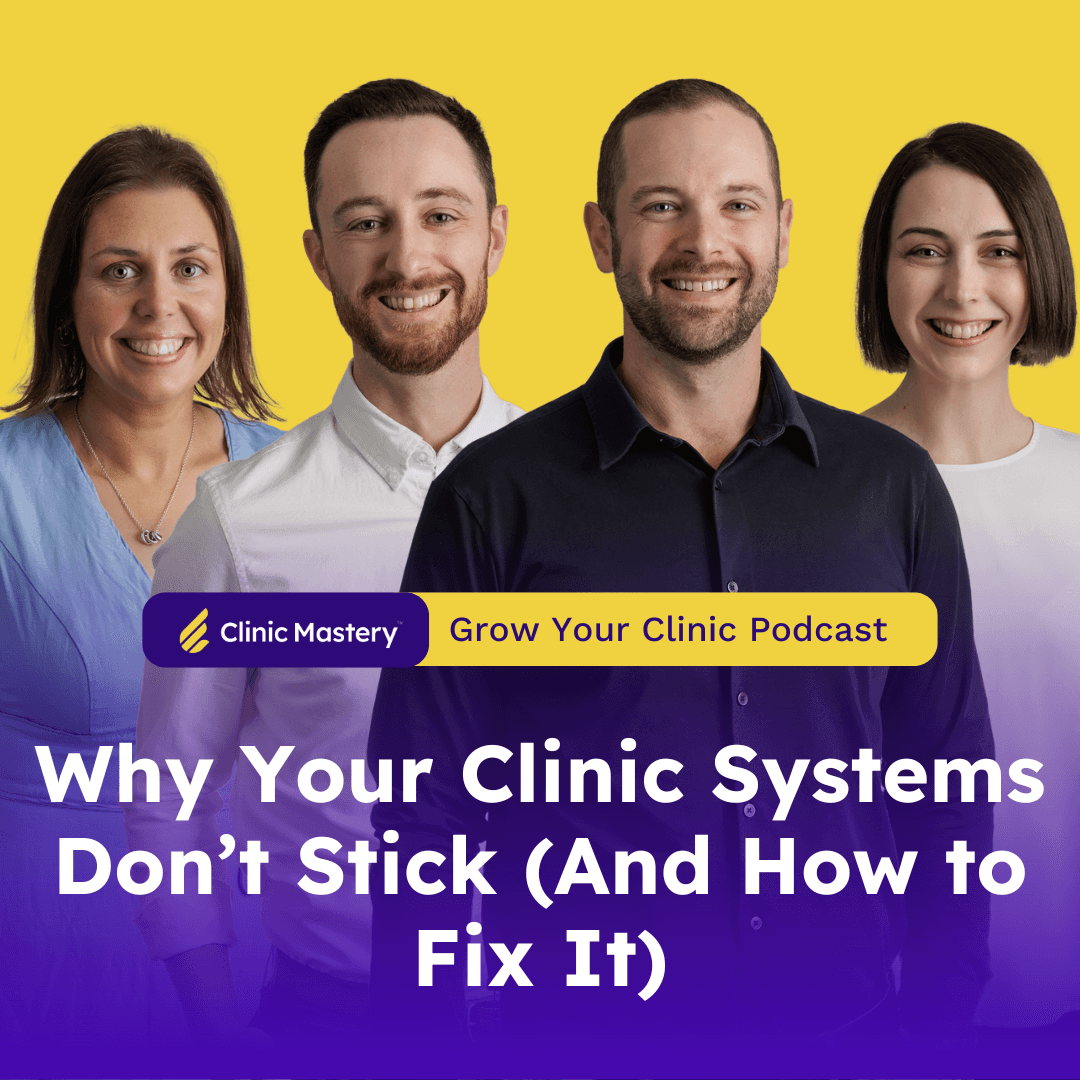
Join Ben and Jack as they give you a true behind-the-scenes taster of what it’s like to work with them! In this episode, they unpack why data - not feelings - should drive your clinic’s decisions, performance and growth. They also walk you through Allie, the platform they use to centralise metrics and training, and even analyse real-life clinic data inside the system - so you can see exactly how the numbers reveal what’s really happening. You’ll learn how Allie brings instant clarity to PVA, rebooking rates, cancellation rates and new client numbers, why an 8–12 week review window uncovers meaningful trends, and how these insights fuel better mentoring, clearer expectations and a more accountable team culture.
If you want to replace uncertainty with clarity and build a clinic that consistently grows, this episode shows you where to start.
In This Episode You'll Learn:
🌟 Data-Driven Decisions: Learn how to leverage clinic data for better outcomes.
📈 Key Metrics: Discover the importance of Patient Visit Average (PVA), rebooking rates, and cancellation rates.
💡 Real-World Examples: Watch as we analyse a clinic's performance using Allie, our digital clinic management tool.
🤝 Team Empowerment: Find out how to encourage your team to take ownership of their performance.
📊 Actionable Insights: Get tips on how to set targets and track progress effectively.
Timestamps:
00:00:00 Episode Start
00:04:43 Screen share walk through of Allie
00:05:41 Real life data analysis for clinic growth.
00:10:03 Why patient visit average matters.
00:14:02 Cancellation rate impact on profit.
00:17:02 Celebrating team performance improvements.
00:21:15 Understanding the narrative behind numbers.
00:24:09 Patient Visit Average Analysis.
00:27:46 Raising standards in patient care.
00:30:39 Average revenue trend analysis.
00:36:29 Accountability in practitioner training.
00:38:14 Key metrics for clinic success.
00:41:41 Mentoring and resource management.
00:45:25 Free trial benefits of Allie.
00:49:37 Simplifying clinic management systems.
Discover more episodes!































Episode Transcript:
Ben Lynch: Good to see you. G'day, good people. Welcome to the Grow Your Clinic Podcast by Clinic Mastery. Here's what's coming up inside of this episode. But we're going to give people a bit of a taste test for what it's like to work with us. What I'm sharing on screen, come and join us over on YouTube where we're looking at some of the data for a clinic.
Jack O'Brien: So you can upload resources and playlists into Allie around how do we train our practitioners on developing late phase care. PVA, rebooking, new clients, you like to see those next to one another. These are some of the big ones. Let me have a look a little bit deeper at what's actually happening here for Amelia's average revenue. The line indicates that it's starting to trend up.
Ben Lynch: Don't use your feelings, use some data, which is, you've changed your tune a little bit on the podcast recently. You've been leaning into the feelings, getting a little bit all mushy. I've never been described as mushy and I don't ever expect to be. This episode will be right up your Allie if you're wanting your team to take more ownership of their performance. We're doing a walkthrough of Ally, and trust me, you'll want to see how Jack spots opportunities for clinic growth using real-world clinic data and what he prescribes as the solutions. Before we dive in, today's episode is brought to you by AllieClinics.com. If you're the kind of clinic owner who loves to feel organised and stay ahead of the chaos, you'll love Allie. Think of it as your digital clone. It's the single source of truth for all your clinic's policies, systems, and training. Test it for free at AllieClinics.com. And in other news, applications are now open to work with us one-on-one at Clinic Mastery. If you want support to grow your clinic and bring your vision to life, just email helloatclinicmastery.com with the subject line podcast, and we'll line up a time to chat. All right, let's get into the episode. So, normally we start off with, hey, welcome to a whole bunch of people that have joined A11y, and it's fairly manageable, which is lovely. But at the moment, the list is just out of sight. And I'm so incredibly grateful for everyone that has jumped on board of A11y to get their data synced, to pull their systems into a single source of truth. Thank you, thank you, thank you. If you need any help, please do reach out, but the list is massive since we've released this new integration with SPLOS, Halaxy and NUCL to build on top of the Cliniko integration. So, guns a-blazin'. That's been hit for six, that's for sure.
Jack O'Brien: Certainly, certainly. And we've had a couple of new members trickle on through since the last episode, so really excited to welcome new members. And I'll say this, for those who have joined or are considering joining one of our programs, now is such a good time. If you fast forward in your mind to January and February, you're going to be grateful for the decisions you make in November and December. Now is the time to do the farming so that you reap a harvest in January, February, March, through the school holidays, through the Easter season, and come out of April absolutely soaring. And so to get amongst it, you can email me jack at clinicmastery.com. We are working through the January jumpstart with those who are looking to get a head start on January. That is jackatclinicmastery.com. We'll have a conversation, see if you're a good fit for us. There's a few folk that aren't, so we just want to make sure that we're able to help. No obligation. We'll make sure we make some progress with you on the session, and if it's right to explore what it looks like to join one of our programs, then we can do so. jackatclinicmastery.com.
Ben Lynch: And it's more than a program to dovetail this in J-O-B. It's more like an advisory of virtual business partnership that we have. And I did not run this by you ahead of today's session, but we're going to give people a bit of a taste test. for what it's like to work with us. In particular, I want your lord brain, your skill set, in how you would analyse where a clinic is at and identify opportunities for where they could get to. How would you coach them through? We could actually use some live data, albeit somewhat dummy data, for how you would use data to make decisions, because you just posted something on Instagram that was something about, don't use your feelings, use some data, which is, you've changed your tune a little bit on the podcast recently. You've been leaning into the feelings, getting a little bit all mushy.
Jack O'Brien: You've gone back to data. I've never been described as mushy, and I don't ever expect to be.
Ben Lynch: Maybe after one of your triathlons, you're a bit mushy. So what if we were to tee this up, J-O-B? I'm going to share screen. And as part of the release of A11y into these new PMS integrations, so many people are asking me, hey, can you show me how it works, how I can use it in my use case? So rather than this just be a long demo, why not apply it? We're going to use this as a bit of an example, J.O.B. What I'm sharing on screen, come and join us over on YouTube, is the Allie interface where we're looking at some of the data for a clinic. And I thought, Jack, you and I could work our way through this clinic. and identify opportunities, even just to see how you skim the data, how you fly through it, how you'd start to identify and then prioritise opportunities to grow. Does that sound all right? Sounds great to me. Great. So you can work on your feet. I didn't even give you a heads up. Here we go. Alright, so the first thing perhaps is over what time period do you typically like to look at data? For me, I find a bit of a Goldilocks number is sort of the 8 to 12 weeks as my regular reference point. Maybe if we're doing it for the first time, it would be over a longer period, maybe like 12 months. But where's your starting point for the period at which you're going to review?
Jack O'Brien: Yeah, I like 12 weeks as a nice place to start. It is the most recent three months and it's enough to see what's happening recently, but also enough to see trends over a couple of weeks period. So start there. I mean, that's one of the beautiful things, right, is you can use some of these predetermined time brackets or date brackets so you can set your own custom. So 12 weeks is the right one for me.
Ben Lynch: Yeah, bit of a Goldilocks number. I like it as well. The whole premise behind Allie is to show you trends. What I've found in reporting, like we've talked about the sickos that just love reporting and data, like they get super deep on it and they probably take a little bit of a sense to that, but you know at heart, you love data, right? You sleep in the sheets, get it? Pun intended. Anyway, yeah, it doesn't get any better from here, folks. So with this, a lot of people are afraid of their numbers. They're not sure how to use their numbers. They don't want to look at it. Maybe they just rely on opening up Cliniko or Splose and looking at the white space in the diary and going, oh, well, I know how full or not full the books are. So I want to talk to some of the specific numbers that you would call on, but we want to show trends over time. A lot of reporting is very static. It's like, okay, I know what it is today, but what was it 12 weeks ago or 12 months ago, and is it getting better or worse? I think so much of this is to show trends. Okay, so we've got time period. We're looking at all practitioners, all locations in one view. We can drill down to practitioner specific and we'll share that in a moment. But talk me through the hierarchy of stats. We have touched on this in previous podcasts around, you know, your top three or your top one metric to go to. Here on our screen, we've got about nine placeholders for us to arrange the data in. Let's configure this. J.B., what do you want to keep front and center?
Jack O'Brien: Certainly service hours in this case or appointments depending on how you define it in your clinic is important as is revenue. In this case or in this example, it looks to me like this clinic has a reasonable percentage of their revenue is to products. It's well over 10%. It's like 20% of their revenue is in products. And for that reason, it makes sense to have it front and center. Not every clinic type is going to need products front and center. Moving from there, I'd be really interested in what we call the CEIs, clinical excellence indicators. So things like insulation rate, rebooking rate. PVA one week and four week forward. That's typically where I would look. So I can't see PVA here. I'd probably swap the service hours one to PVA because we've got service hours up above in the main one.
Ben Lynch: Let's do that. Patient visit average. This is one that in particular a lot of the MSK professions want to be able to track, so your physio, your pods, your EPs, especially in physio landers. On average, how many visits does a patient come in for over the course of their lifetime, so I can get a sense for their journey? Now, they might come in episodes. Some people like to break it down even further. So they might come in for an episode of care where they come for five visits. Maybe they've got some resolution and have been discharged. And they come back a year later with a different problem for five visits. And then we total that up for 10 visits as the visit average over their lifetime. So that's patient visit average. So you want to see that. Can we go down a little bit deeper on that one? Like why do you say you want to track PVA? I might actually put it front and center on our chart so we can see it more easily. Do you want to just labor on this one a bit more? Why does patient visit average matter?
Jack O'Brien: It matters on a couple of levels. So if we start clinically to begin with, we want to make sure our clients are getting a full and complete recovery or progress on their plan. And so this will vary by profession and by types of conditions you treat. But generally speaking, we have a rough idea of what that PVA typically on average is. And so we don't want to necessarily over-service. I rarely see over-servicing beds. I almost pandemically see under-servicing. And so, our patient visit average allows us to see are we adequately servicing our patients by ensuring they have enough sessions to get the outcome that they desire. And so, that would be clinically. Commercially, when we think about the lifetime value of a patient, that is the … Now, of course, patients are worth more than their dollars, but for commercial intents and purposes, we want to think about how many visits do they come and what is the average fee per consult, and that is what helps us understand the lifetime value. If our patient visit average is low, our lifetime value is low, that means our churn is high, Is our marketing costs are a high percentage? All these factors. So that's what goes into it.
Ben Lynch: It's a really good point. And typically this is one of those stats that will be shown just statically, like your PVA is X, you know, it's eight or it's 10 or it's 12. So what I love and what we've set up here is to show the trend. Is it getting better? Is it getting worse? Is it staying about the same? You can see on the chart here that. Essentially, over the 12 weeks in reference, it's about the same or similar. It's slightly better, but what you see in the top right here is we're about 11% better in this 12 weeks compared to the previous 12 weeks. So, you can again see the trend within the time period and outside of the time period very quickly. But we're above the target. That green line on the chart is sitting at 9.3 as the visit average target across the board. And how did that target come to be, Ben? So, when you click on the targets, you're able to set them at an individual practitioner level. And this is one of the downsides we see a lot of people who might come to us with their own scoreboard or dashboard or use a legacy version that we've had and created, where they've got targets perhaps individually for therapists, but maybe they don't get updated regularly enough or to reflect changes in expectations. And then secondly, they don't actually add up to a total overall. So, you can't see the clinic or clinic locations in an overall versus the target. So, actual versus target. So this just allows you to set it very quickly and easily. Set the same for all practitioners or nuance it depending on maybe they're a new graduate versus senior. Maybe they work half-time versus full-time. So it allows you that flexibility. Yeah, what I see from patient visit average here is that it's got a reasonable trend up. That looks like we're nurturing our patients pretty well through a journey of care. Let's dive into another one of those metrics that you mentioned, Joby, which cancellation rate gets talked about a lot. It's obviously a smaller impact number, even if we make some meaningful differences in the results. Commercially, they're still relatively small compared to some of the others like rebooking or patient visit average. But let's spend some time unpacking it.
Jack O'Brien: I mean, it is and it isn't. So everything's relative, okay? But I would say that cancellations is one where we can make a meaningful shift to profit. So one of the ways to think about cancellations is you're already paying your team member who is there. If someone cancels, that therapist is just sitting around. All of your other operating expenses still exist. And so a cancellation is almost entirely profit that has been lost. is one way to think of it. And so, if we can move the needle on cancellations, in this example, it's nearly 14%. If we can get that down to 12% or even 10%, that would be a meaningful, in this clinic's case, it would be tens of thousands of dollars a year annualised as profit. And so, you think, oh, there's not that much difference between 14% and 12%. Well, if we frame it up as 50 grand a year, that's a pretty good holiday for your family for a couple of weeks. That's a very good holiday for your family for a couple of weeks. And so there is a lot of opportunity missed in the minutiae that we can see now here in Ellie.
Ben Lynch: And when you click actually on the title of a chart, you can drill down even further and see the individual team members and their relative contribution to that figure. So down on the left-hand side here, we've got Addison, Amelia, Angus, Darcy, Dylan, Elena, and the list goes on. You can see their target, their actual, and their trend. Again, are they getting better or worse?
Jack O'Brien: Well, if you stop there, Ben, and scroll back up to the main clinic, you look at that line and go, well, it's above the target, so that's a problem. It's mostly somewhat consistent week to week. There would be normal expected variance. And you can see in the top right-hand corner, it's trended better than the previous 12 weeks. So you might look at that and go, oh. It's stable, it's coming down compared to last period, 13's acceptable. But if we come down now and look at practitioner by practitioner, what we can see here is folks that are really missing the mark. Angus is where my eyes go to. Angus. The next Angus, the second Angus Allen. Oh, yes. Like 36.9% on a target of the next one, yeah, that bottom one, on a target of 10%. These numbers are to be, in some regards, canaries in the coal mine. They kind of let us know there's something going on here. And conversely, Amelia, the second name, she's pretty close to target and she's improved like 31% since last quarter effectively and so she's doing a ripper job. In the first instance, I'm walking out my door straight down the corridor and high-fiving Amelia mid consult. She's doing something super well. Just interrupt. She's doing a really good job. It not only allows us to find problems to critique and to fix, but opportunities to celebrate in real time and acknowledge good work and acknowledge progress. I'd be using that as a coaching moment with Amelia to say, hey, what's the secret? Tell me what you've implemented over the last six to 12 weeks that has meant your cancellation rate has improved because you've done a ripper job, Amelia. on executing on that scripting or the way you're presenting management plans or how you're rebooking with confidence. Whatever you're doing, let's learn from it because it's working.
Ben Lynch: And from here, it's easy to go over to Amelia's hub, and we can share this with Amelia securely so that she could see only her stats, nobody else's, and not the clinic's overall. That allows her to have some ownership over her performance. And we can constrain what stats are here, because Jack, sometimes clinic owners will say to me, I don't want to share any revenue-based statistics with my team for a few reasons. Maybe they just don't want them thinking about the money side of things, fair enough. Or maybe they actually just want to simplify their focus, like they're working on rebooking or cancellation or new clients. And so they're going to just constrain the suite of stats that they can see in their login. So now we're over here in Amelia's hub. We could invite Amelia to Allie so she could see these stats. What I like as well is depending on the focus for mentoring, I would out, I would position these metrics here in a way that focuses on the main thing. So perhaps we are focusing on rebooking or cancellation in that example. And so I'd want that front and center. so that we could anchor to it in our mentoring conversations. When it comes to those conversations, JB, what have you found a tactful way to talk about numbers without making it all about the money?
Jack O'Brien: Yeah, it's a really good question. So when it comes to talking about numbers with your practitioners, you have to take it slowly in the first couple of sessions, particularly if it's a foreign concept or they're not familiar, they're a little bit anxious. We need to make sure their first couple of experiences are really pleasant, non-threatening, and are really about educating and upskilling before we start dropping the hammer on opportunities to improve. In the first instance, I'm looking for opportunities for high fives and I'm helping Amelia start to understand her data and showing her where she's doing a really good job. That is the first primary use is highlighting where folks are doing a good job and getting them to reinforce the actions that have led to a good outcome. And so in this case, I'd be saying to Amelia, we're looking at rebooking rates here. There's clearly two out of every three weeks, Amelia, your rebooking rate is above the target. We've got the target at 90% and you're hitting 100% rebooking on whatever the max is there. Six weeks out of 12, you're above the target. How did that happen? You know, what is it about those patient types? What is it about your scripting that you're able to rebook? And talk me through maybe some of the other weeks where it didn't quite go to plan. Yes. Need to hold you over a barrel, but just talk me through those weeks. Is there anything that comes to mind? Now, she might say, oh, there was a public holiday coming and so I wasn't, you know, the patients weren't able to come on a different day or she was sick or whatever the case may be.
Ben Lynch: It's a really interesting point, and when you see that in the context of some of these other stats now, as I scroll down and see cancellation rate quite obviously next to it, even though cancellation rate has improved meaningfully, as you called out before, close to 32% in this period of time, You could actually see it trending worse.
Jack O'Brien: Right. Very interesting. It's trending worse in the last six weeks. But she had a couple of weeks there where it was 0% cancellations. So there's some peaks and troughs here that we just need some context on. And so often we described in our podcast episodes and series around our finances and zero, that we need to understand the narrative behind the numbers. And so that's where we're starting to tell the story of what's been happening. What was it about that week where we had 30% cancellations? Oh, you were just sick for the week. You had to cancel most of your diary. What about those weeks where it was zero? What led to that? And understanding the story behind the statistics that we're looking at.
Ben Lynch: It's a great coaching moment for you to ask that question of the therapist, right? To just help me understand, you know, some of the reasons why you see this happening. And also to try and figure out, okay, rebooking's going really well for Amelia here. But cancellations are creeping up, so we're rebooking them, but maybe then they're getting to their appointment time and cancelling to what degree is, you know, that's just out of your control, the kids were sick, you know, got caught up in traffic, so I had to cancel my appointment. We've rebooked them, but they don't actually know why they're coming back. Is there an opportunity for the communication in their treatment plan to be better, to understand what we're going to do at the next appointment? So, despite the improvement, we're always looking for little opportunities like that for practitioners to be better in their role. What else are we seeing over here, JB? New clients, the weekly target is set astronomically high at 10. I think I might have done that just as part of demonstrating how you can change targets for some folks. I'll update that to three just so you can see.
Jack O'Brien: And you see the charts move there, the target gets set and all the lines kind of move to scale. So what we see there is she's relatively consistent, particularly over the last few weeks. Now we can see that there were really three weeks here where it was 1-0-1. And that's really going to negatively skew those stats. But by and large, that new client number is what she's hitting and it's improved from the previous 12 weeks. So I don't necessarily see a concern. And you're right, Ben, the challenge is to view these numbers, these KPIs in context of one another as well. So I'd be interested perhaps to look at her new clients next to her rebooking rate next to her PVA and so maybe you could do that, change the appointments and cancellation to rebooking. and to PVA and this for me as a clinical mentor gives me a little bit more context as to what's happening. Amelia is not getting heaps of new clients, two a week on average. By and large, she's rebooking really solidly and her PVA is about on target on average is at five and you can see there on the chart, it hovers between five and six. So she's probably doing a pretty good job with those new clients. That's what I see there, by and large, doing a really good job.
Ben Lynch: One of the nuances here to PVA, patient visit average, inside of ALI is this. We calculated on a rolling 90-day window because the best assessment would be over the entire lifetime of that practitioner or over the entire lifetime of that patient, depending on how you're looking at it. on average, how many visits do they come in for? But if we're looking over that time period, there just wouldn't be a lot of fluctuation. It would be hard to see if it's trending better or worse. And to measure it on a weekly basis is just way too frequent. You see these massive swings and roundabouts. So what we do is we actually look at, say, today's date and the previous 90 days. And we say, what is the visit average over that period? And we take a snapshot. And then we go another week into the future, and that 90-day window just slowly moves along with us so that we can see whether it is increasing or decreasing. Because you could have a massive influx of new clients, and it'll make your PVA look really bad, really low, as an example. So, we like to capture the rolling window there, which is a unique way of looking at it inside of A11y, but it's what we've done over a decade now working with clinic owners to help them have stats that they can use. You can be soaked in a swamp of stats, but if you're not using it, you don't know how to use it, then you're not going to make the gains that you could otherwise do with a practical suite of just what you need. coffee and good company. But anyway, PVA, rebooking, new clients, you like to see those next to one another. These are some of the big ones here. What are you seeing from this now that they're all together?
Jack O'Brien: Yeah. To me, as those new clients have come through consistently, that naturally creates a little bit of a dip in the PVA. She's doing a fairly stable job of her rebooking. Again, it ebbs and flows a little bit, but that's okay. There's natural variation. Absolutely. Then we're asking, is the target appropriate? Do we need to move the target or is the performance appropriate? Do we need to change how Amelia is performing here? Are we projecting appropriately or performing appropriately? And so we might look at this and go, well, that PVA is probably – we could set the bar a little bit higher. We set the bar at five. We don't know. It's a fictitious practitioner and profession, but maybe five. Look, for our clinic and compared to some of the high performers in our team, we need to move that target now that you're consistently hitting 5. We need to move that closer to 5.5 or 6. And so we start to lift the bar and lift those expectations on Amelia. And so then it comes down to clinically coaching her through it. We might say, well, Emilium, how do we treat our patients towards the end phase of their rehab, assuming this is an MSK acute type arrangement? Because typically, practitioners, those early in their career, are very good at their assessment and early phase treatment, but they often have a lot of opportunity to upskill when it comes to planning out the care of patients and maximising the middle and later stages of rehab. So my mentoring conversation would go, all right, Amelia, it's time for you to lift the standard that you expect of yourself and that we expect of each other towards a PVA of six or seven. That looks like helping your patients with an additional one or two sessions. What do you think you could do to really add value, to make this an obvious no-brainer for your patients? Is there some additional strength training capacity testing that we can do? Can we upskill you when it comes to your exercise prescription? Can we help some of those patients that are interested in maintenance care, knowing full well, you know, patient informed, patient centered, blah, blah, blah. But if those patients want ongoing care, how do we make it easy for them to continue to invest in their care? So they're the types of clinical upskills, assessments, treatments, and planning conversations that we'd look to skill our team members in so that they can progress the PVA.
Ben Lynch: Yeah, it's a really good point about how this is just living and breathing. You're continually making small adjustments in collaboration with your team members and getting them to do that self-analysis and reflection as well. I found that quite useful in a mentoring conversation. We've so often talked about using a Google form. You can use whatever tool you like to have a bunch of questions that get filled in prior to a mentoring session as part of accountability or a forced reflection piece. And so often we'll use a question or two around their dashboards. Like what are some of the insights that you've gleaned from your numbers this week or this month or this fortnight? And what do you need help with, or where do you see the opportunities? I don't know if you've got any other questions that you'd like to ask there, Jack, when it comes to reflection on numbers?
Jack O'Brien: Yeah, I usually ask, like, what do you see that's worth celebrating? And what have you been working on? And where do you see the opportunities? It's a bit of a traffic light type system. Yeah, yeah. But a lot of things come out of the conversation too, right? Like you just got to talk it through and the neurons connect lots over time.
Ben Lynch: There are many other stats inside of Allie that you can choose from the drop-down menus. We've just got nine here. I think so many people, and I said it tongue-in-cheek before. They do want to have all these stats and it just becomes overwhelming. You can't really get any signal from the noise. So try and really make this simple. I think that also helps with adoption because you don't want to have all this data in front of you as a clinic owner but then your team don't get on board because that just increases reliance on you, right? So you want this to be in a way that your team embrace it, they adopt it, they use it, they reference it. So we try our best and continue to make refinements to simplify this so that it's super easy to spot trends and opportunities, prioritise your focus and have your team most importantly on board with this. Yeah.
Jack O'Brien: And I really love the way that Allie allows us to find that signal that we can then press deeper on. I'm looking here at the average revenue and interestingly, it says it's down a little bit compared to the last period. But before you click on anything, Ben, what I can see before you change it is that the line, just the curve trend line looks really positive. Yes. I catch that with my eyes and that allows me to go, oh, now you can click on it. Let me have a look a little bit deeper at what's actually happening here for Amelia's average revenue because the line indicates that it's starting to trend up. What's actually happening? And we could see where it was consistently in the low 120s, that line chart is slowly trending up and to the right. And so where it was in the low 120s to begin with for this 12-week period, notwithstanding a week that looks like of sickness, You know, those last four weeks were above $130 where it used to be in the low 120s. Again, high five Amelia and talk me through what's changed. Something's changed and so how can we attribute that behaviour? So we can see here with Amelia, her PVA is really solid, her rebooking is solid, her average revenue is going up. However, however, again, here's something that just caught my eye and now we need to press in on it. Down in the bottom row there, we're looking at the second and third tiles, the DNA tile and the cancellation rate title. Now, initially, we saw the cancellation rate improved 30%. Oh, that sounds pretty good. But I'm looking at next to it and DNA has got worse by 30%. And so I'm going to assume here, Ben, that this has actually got nothing to do with Amelia. It's probably more an administrative change in how the front desk team, the practice administration team, customer support team. There's been a behavioural change in how they are handling data inside Halaxy, SPLOS, Nuke, or Cliniko, whichever platform you're using. So it's actually got very little to do with Amelia and probably a lot to do with maybe there's a new team member who keeps clicking DNA instead of clicking cancel. And that had meaningful impact on how we mentor Amelia. So we've got to catch these things.
Ben Lynch: Really great point. A lot of the signs that I see here are really positive. It looks like Amelia would be a part-time team member just by the amount of appointments that they're doing. Looks like reasonable fundamentals here on the nurturing of clients, the ability to serve the new clients that are coming in, the ability to provide high value care and receive that on an average revenue basis. I'd be looking at, can we get Amelia More days of the week. What's going on? Obviously, we're using some data here that's anonymous, anonymised, so we're unsure of who Amelia really is. But this would be one of the things I'd be looking to heading into the new year. What does your week look like? How can we continue to give you more ideal clients? The visit average is reasonably low, so I'd be looking at the back end of care, if you want to call it that. How are patients finishing?
Jack O'Brien: And so maybe that leads us through to some of the resource or actions tab. I might say to Amelia, well, let's work on some of those training concepts. So you can upload resources and playlists into Allie around how do we train our practitioners on developing late phase care. Maybe it's about exercise prescription or maybe it's about how we communicate with patients at the end stages of their rehab. You can see here how to reduce cancellations. And so we might copy the link to this resource and come back to Amelia's page and paste it as an action. Yes. based on our mentoring for Amelia to read this particular resource. And you can see here, Ben, down the bottom, that Amelia can acknowledge that she's read this resource if we've got that turned on. Some of these resources enable us to ask our practitioners to acknowledge it. You can see here, requires acknowledgement once or annually or whatever the case may be. And so we can therefore link the data to our training resources through to our mentoring actions. And it's all seamless, all in the one place. And Amelia can log in and only see what Amelia needs to see. She doesn't need to see the NDIS training for admin. She needs to see how to reduce cancellations as a therapist.
Ben Lynch: Yeah, so we can add Amelia over here and just click share. Bang. And then she'll get an email saying you've been shared this specific playlist and it will show up in her login in the resources section that we were just on. Super easy to do. And JRB, like you said, with acknowledgements. Down the very bottom here, we can see Addison and Olive have not acknowledged this resource called How to Reduce Cancellations, which we shared with them in their mentoring session. And so we want to just follow them up and make sure that they've seen it and that they read and acknowledge it. That also all gets centralised back over in the home section when we see resources, and there are eight pending acknowledgements. So we can see those resources are over here. So Elena, Olive, and Zoe need to acknowledge those. Maybe they've been on leave, maybe they're sick, been on a great European holiday to the sun, sounds really good. and haven't had time to do it. But definitely the accountability conversation can be, hey, just making sure you saw this. Can you acknowledge it?
Jack O'Brien: And this is such a useful little module, Ben, on the homepage here, where we can see the team members and we can customise which of the quick stats we can get a traffic light view on. We've got cancellation rate, patient visit average and rebooking. My three favourites are sitting there and we can see that rebooking for everyone is pretty solid. PVA is close enough, two greens and a yellow, but that top practitioner, the cancellation rate is a problem. and need support. So as an owner or a clinical mentor, I can quickly glance at this, know that we as a team in our culture day have prioritised this 90 or 120 days to focus on client experiences and cancellation rates and Eliana needs support. She doesn't need criticism. She just needs support. She needs us to come alongside and help her out and we can dive into her data and do a similar thing when it comes to mentoring.
Ben Lynch: As an owner, I think a really important thing, we've talked about this on the pod many times, is your weekly rhythm and also how you look at some of the data you have available, whether it's inside of Allie or inside of Xero, your accounting software, how you might have those habits in your week where you can review things. And then being able to set up your dashboard so that you don't have to go through all the charts and all the team members. It's not meant to be like that. You may just have a couple of key focuses. and look at how you're trending, identify some insights, make some decisions, take some action, and then repeat the cycle. I think when we're preparing then for a mentoring session with a team member, we're going to look at their specific stats and get an overview of what's happening, and then essentially form an agenda that we talk through and then prescribe some actions off the back of there.
Jack O'Brien: It's a really good point, Ben. So here's my observation, is that Early stage or amateur clinic owners are addicted to too much data. And what we see is that the best clinic owners narrow their focus. They put on the blinkers and they focus on one or two key metrics for a period of 90 days. They focus their actions, projects, outcomes around those couple of metrics and they execute to a point where they are mastering it. It's all about mastery. And then the next 90 days, you can move on. And Mick Riske explained this beautifully at our Grow Your Clinic Summit for our members, 300, 350-odd members in attendance in Melbourne in 2025. And Mick describes like some of us get so frustrated by only working on one or two projects at a time. But the reality is, is that in a 90-day period, that happens four times a year, if you focus on two metrics in each of those periods, that's eight metrics. There's not many more than eight key metrics in a clinic. You can nail them all in a 12, 8, and 24-month period with focus, intentionality, and mastery.
Ben Lynch: And I see it all coming to revenue, really, in this instance. We'll go to zero to look at some of the costs and the profitability side of things. But a lot of this is just anchored to revenue. I feel like you go down the tree, so to speak. to find out, okay, well, how did we arrive at that revenue? And so often you come back to, well, new clients and the rebooking or retention of those clients. And so you can see on my screen, I've got rebooking revenue and new clients. And we can go and look at some of these others like service hours for a lot of the paediatric clinics, you know, speech OT psych, or you're working with NDIS type clients, they want to know that instead of say appointments. That's pretty reasonable as well. But you don't need to go too far down the tree, right? You're just trying to find the big meaty bits that, okay, we can make a difference. And for so many clinics, it's usually new clients. Oh, I need more clients to come in. I've just hired or expanded to a new site. Is there sufficient new clients coming through? And then on the back end, how well are we rebooking according to the care plan for those patients? So it's retention stats like rebooking and cancellations. And really, they're kind of like the go-tos that I would have. I don't want to overcomplicate it. I feel like you can try and over-engineer a whole bunch of things. So, they're my starting points.
Jack O'Brien: Yeah, I really like it. And a good way to think about it is from an exercise prescription software, exercise prescription perspective rather, is what is the minimum dose required to get an outcome? So, we don't want to be approaching Allie with like, how many metrics can I access? Do you have the 76 potential metrics that I can measure? No, no, no. What's the minimum number you need in order to be able to mentor your team appropriately? You want as minimal as possible and we don't just want data for data's sake and that's why we built Allie then is we saw clinic owners get hung up on spreadsheets and numbers and not do anything with them. If your numbers don't lead to mentoring, actions that are connected to resources, you are missing it. If you're just assessing numbers for numbers sake, quit your job, sell your business, go and get a job as a statistician somewhere. You'll make a great living commentating on the cricket, calling out all the stats. But your numbers must lead to mentoring, which, and mentoring is not just telling someone what to do. Mentoring is helping someone get to a place where they understand the actions that they need to take with the accountability to support them and the resources required to do the job. And they all live in Allie. It's not scattered, hidden across the internet, gathering virtual dust in some cloud somewhere. Allie is the place for everything to live.
Ben Lynch: Well, J.B., as we look to wrap, I just want to share a couple of things that I get asked about. How should I set up some of the resources side of things? A resource is the terminology we use for any policy, procedure, training, any document, audio, visual that you want to share with your team. It's a piece of content you want to share with your team that you can do in Allie. And we've got these sections called Training, Policies, Procedures, and Company. Some really great examples of playlists include onboarding new team members, getting them familiar with the vision mission values, orientating them physically to the space, giving them all the things they need to understand about how payroll and leave work inside of A11y. And there's over 120 20 resources that are done for you, ready to plug and play inside of A11y. You don't need to start from scratch, which is perfect for the new clinic, but especially good for those clinics that they've created a version, but it's gathered some digital dust over the years and no one really looks at it or uses it. To have it fresh in A11y is a really great way. But Therapist CPD, Admin CPD and Training, Customer Experience, the new Patient Experience, scripts potentially using on the front desk. are really great playlists that you can create pathways for career development at the clinic. How we do marketing, like our tone of voice, our brand, some of the assets that you've got can easily be stored and shared inside of Allie so that people are looking at their data and they're accessing their documents all under the one hub. It's super easy for them to be able to do
Jack O'Brien: particularly as it pertains to compliance. So if you're in the NDIS space, support at home, maybe you've got a bunch of policies, we've got 120 odd of them ready to go for you that are compliant, but maybe you need to have your team members acknowledge those each year. It's an annual refresher. And you can see here, we can see when they haven't acknowledged when it's pending. Maybe you need some certifications, first aid, working with children's checks, green cards, blue cards, depending where you are. And so we can house all of that here. And we know that our team are up to date with our policies. We know our team are up to date with some of their certifications and when things are expiring soon. So we can stay on top of it before that date comes.
Ben Lynch: Yeah, super important. Working with children, check, police check, first aid, CPR, professional indemnity, insurance certificate of currency. There's all these things you need to have on file and so often they're out of date and haven't been renewed in a timely sense. You can do that inside of A11y. For some of the resource packs that you get out there for different clinics, you pay several thousand dollars, maybe three to five thousand dollars in this kind of come in document form. You've got that all inside of A11y for a very low monthly fee, and you get the ability to share it securely and see whether they've acknowledged it and have that on file, and it's all automated. It's pretty easy, especially with a free trial, for you to check out whether this is the sort of thing for you or not.
Jack O'Brien: We lengthened that free trial recently, didn't we, Ben?
Ben Lynch: Yes. Yeah. 30 days. You've got a month to test it out and see how it works. You get the full experience on the free trial. There's nothing hidden from the free trial compared to the paid version. I did get asked that question yesterday for the first time, so I thought I'd clarify. Maybe there's more folks who have the same question. And we do regular live onboardings and demos as well. So you get the support.
Jack O'Brien: I was having a conversation with someone just this week about the value of Allie compared to the low monthly subscription. It's like, well, if this helps us help our practitioners to increase their PVA from, in that case, from five to six, that's a 20% improvement in PVA. that equates over time to a 20% uplift in revenue for just one practitioner on Amelia. On Amelia alone, that dummy example that we just used, we're talking about an increase in revenue for her. She was doing about 70 grand a year in revenue. We're talking about at least a $7,000 revenue uplift for Amelia alone. And Allie is a fraction of that. Allie is like, I don't know, how's my maths, like 20% of that. So, that's one practitioner in that clinic of dozens. So, it's a no-brainer. Whatever the investment is, I don't know what it is at the moment, but I know that you'll make at least 10x whatever you're investing in Allie, you will absolutely make back in revenue growth. and team satisfaction and peace of mind as a Cliniko. I remember, Ben, here's how I used to do it. I used to get home on a Friday night, I'd pour a glass of wine. If it was this week, I'd turn the ashes on because it's on Perth time. How good is daylight savings when it's Perth? I'd sit down of a Friday evening with a glass of wine and I'd spend two hours punching, copying data from Cliniko into a spreadsheet and then I'd have to try and figure it out after a couple of glasses of wine where my KPIs are at. And it's like, well, you know, that couple, that two hours a week is a hundred hours a year, you know, from a billing, if I was to see patients or generate new clients, that's a hundred thousand dollars worth of my time. Now it's, I don't know, a hundred bucks, a couple hundred bucks a month, whatever. all of the data is there for me. I don't have to look at it through Shiraz eyes to try and figure out what's going on. That's how people are doing it. It makes zero sense to manage your own data, copy and paste and try and interpret it yourself. Zero sense.
Ben Lynch: Yes. Look, there's always going to be the power BI, people that just love their setup. That's okay. A11y might not be for you. It is not for everyone. It's for folks that want to just simplify things and have it all under one hood for a very low fee and that your team actually use. So check it out. It's free to test. How do we check it out? A11yclinics.com. A11yclinics.com. Otherwise, send me an email. Here you go. Ben at clinicmastery.com.
Jack O'Brien: You know, folks, Ben told me this week that he checks his email every day. So if you've emailed him before and you haven't heard back from him, he saw it. He just ignored you. Let me tell you this.
Ben Lynch: Currently, I have seven emails in my inbox.
Jack O'Brien: Oh, you beat me.
Ben Lynch: But people like looking to me, I'm quite a social animal. Look, that's what happens when you hit archive all. I joke, I joke, I joke. No, given the rollout of these new patient management systems, my inbox has been lit up more than your Christmas tree. good way, lots of people giving feedback, needing support, asking questions, so I've been hot on it.
Jack O'Brien: Hey, I'll say this too, Ben. If you're an A11y user, and we get these almost every day, we get feedback from A11y users who are loving it. They're like, this has changed my life, this mentor and that mentor. If you're a raving fan, get in touch. If you want to spread the word and you want to help A11y, help other clinic owners, if you've got people in your network, just let us know. Send an email. If you're a raving fan, we've got a few things up our sleeve that we could maybe talk about for 2026.
Ben Lynch: Yes, we definitely can. We definitely can. Well, that was good. Good to get a bit of an insight into how you do it, J.B. I think every time we've gone through dashboards, Allie zero with clinic owners, there's always some version of like, oh, you made that seem really possible or achievable or simple. No doubt there are folks who are tuning in, watching in, that have quite a high degree, they're power users of spreadsheets or, you know, BI. And, you know, you've got your process and this might be rather simple. But I also challenge you, how complicated does it actually need to be? We're in quite a simple industry of services and service hours and appointments. So, yeah, maybe into 2026, how can you simplify I think that's always the challenge. It's certainly a thought that I have is amongst growing and always wanting to be better or refine things, how does that also include simplification and distillation rather than just adding and completing or making things more complex?
Jack O'Brien: I like it. It's an art that we learn over time.
Ben Lynch: Yes, we all get the humble experience of being in business and thinking, ah, look at all these whiz bang ways to do things. And you go, you know what? Simple, simple works. Well, JB, thank you so much for your insights, and we'll catch you on another episode very soon. Folks can head over to clinicmastery.com forward slash podcast for the show notes for previous recordings and a whole bunch of free assets, resources that you can download into your business. Plug and play. People are always giving us feedback on that. Download the book, the podcast. There's so much goodness over at clinicmastery.com. Go check it out. All right. We'll see you soon.