Subscribe:



Ever wondered why some clinic owners completely transform after coaching - while others just get busier?
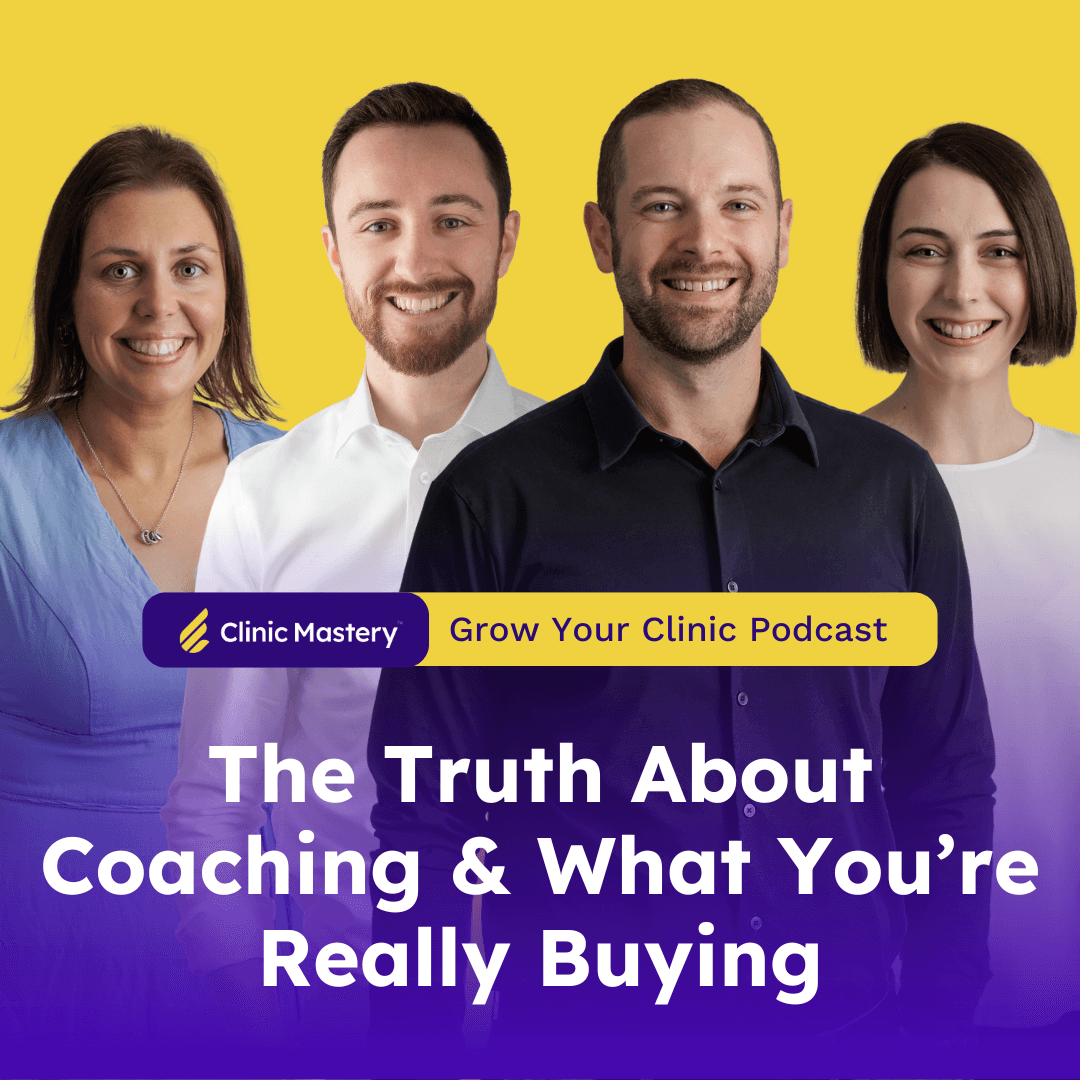
In this episode of the Grow Your Clinic podcast, Ben, Hannah, Jack and Pete dive into the real ROI of coaching, and why it goes far beyond revenue, systems or ticking off tasks. You’ll hear how the most meaningful gains come from personal transformation, better decision-making, clearer leadership, healthier boundaries and a mindset that frees you from overwhelm. We unpack how coaching helps clinic owners identify blind spots, delegate with confidence, and shift from daily firefighting to strategic leadership. Plus, Hannah shares how strong systems and the right support team allowed her to take three months of maternity leave while the clinic continued to thrive.
If you’ve ever wondered whether coaching is “worth it,” this episode reveals why the true payoff is who you become - and how that changes everything for your business and your life.
Need to systemise your clinic? Start your free trial of Allie! https://www.allieclinics.com/
In This Episode You'll Learn:
📈 Is it normal to feel uncomfortable in good coaching?
💰 How to measure your return on investment with a coach
🧠 The importance of accountability vs. advice
🌍 The impact of coaching on your personal and professional growth
🏖️ Strategies for stepping back from day-to-day operations
Timestamps:
00:00:00 Episode Start
00:05:04 Overrated Vs Underrated Coaching Questions
00:06:01 Coaching discomfort and growth
00:09:33 Should you ever graduate coaching?
00:15:02 Return on investment of coaching
00:18:12 Overcoming business leadership challenges
00:21:15 Importance of coaching for growth
00:25:18 Investment and return in coaching
00:28:11 Importance of having coaches
00:31:38 Group coaching vs. one-on-one coaching
00:36:41 Minimum effective dose in coaching
00:40:51 Justifying coaching investments
00:42:35 Creating impact through coaching
Discover more episodes!








































Episode Transcript:
Ben Lynch: Are you both working in January?
Jack O'Brien: Yes, for the first two weeks. And then we're in Thailand for two weeks.
Ben Lynch: Yes. Why did you invite me to your family holiday in Thailand?
Jack O'Brien: Did I?
Ben Lynch: Yeah.
Jack O'Brien: Well, you're welcome. No, I don't think I did.
Ben Lynch: You did. It showed up. Why would I make that up? It's the holiday leave calendar. I was invited to the O'Brien's Thailand experience.
Hannah Dunn: Now, Ben, we'll teach you how to use different calendars. You invited me. You've since changed it.
Ben Lynch: You've since changed it. Yeah, of course I have. G'day, good people. Welcome to the Grow Your Clinic podcast by Clinic Mastery. Here's what's coming up inside of this episode. Is it normal to feel uncomfortable in good coaching?
Jack O'Brien: The objective should be to get the most by doing the least. To put it in health professional terms, it's minimum effective dose.
Hannah Dunn: Clinic Mastery is the third coach in which I had and I really felt that I outgrew the two before.
Peter Flynn: Right, Clinic Mastery, we don't have lock-in contracts for that reason. Right, we don't want people working with us because they're forced to work with us.
Jack O'Brien: Sometimes there's an intangibility to transformation. It's not all ones and zeros on a profit and loss and a balance sheet. And so the outcome of coaching is who we become.
Ben Lynch: A good coach speeds you up. A great coach slows you down.
Peter Flynn: Yes. I plead the fifth to this question.
Ben Lynch: This episode will be right up your Allie if you're looking to grow your clinic in 2026. We're diving into getting a return on investment when working with a coach. And trust me, you want to hear Peter's key insight on how to de-risk your investment. Plus, stick around for when Hannah talks about stepping back from the day-to-day operations in her clinic. Before we dive in, today's episode is brought to you by AllieClinics.com. If you're the kind of clinic owner who loves to feel organised and stay ahead of the chaos, you'll love Allie. Think of it as your digital clone. It's the single source of truth for all your clinics, policies, systems, and training. Test it for free at AllieClinics.com. And in other news, applications are now open to work with us one-on-one at Clinic Mastery. If you want support to grow your clinic and bring your vision to life, just email hallowettclinicmastery.com with the subject line podcast, and we'll line up a time to chat. All right, let's get into the episode. It's episode 330. I am again joined by Jack Oberyn, Hannah Dunn, director of DOTS, an OT service in Melbourne, and Peter Flynn, who's 1% better every day. touring the world, helping clinic owners, former physiotherapist and clinic owner at PhysioFit in Adelaide. My name is Ben Leach. We're here to talk about what we do every day and how we can help clinic owners who currently work with a coach, how to get more out of them, hopefully. And we do have a lot of members who listen in to the show. So we'll talk about that, how you can get more out of CM. But if you're not working with us, you're working with someone else, come over, but also how you can get more out of it. And if you've never worked with a coach, We'll reveal some things behind the scenes. How does it work? How can you get the most out of it? I can give you some tips and tricks to build your support team so you can grow your clinic sustainably. But before we do, Jack O'Brien, plenty is happening on the news front. I'm going to give a welcome to just a few folks that have joined A11y because we've launched the new integrations with Splose, Alexey, NuCall to build on the Cliniko integration. Grant, Ellie, Claire, Hannah, Brad, Tom, Leah, and Shane were just a few at the top of my feed because it went live last week. Welcome. Thank you for testing out A11y, all the data and numbers in your clinic to support your team's performance and all the policies, procedures, and training so you systemise your clinic. J.O.B., what's come across your desk?
Jack O'Brien: Yeah. Similarly, there's been a flurry of clinic owners reaching out for help to grow their clinic, which is fantastic. So a really warm welcome to Isaac and Casey, who are up in the Brisbane Gold Coast area, Annalise, who's an occupational therapist, and Stacey, who is a podiatrist. They're at the top of my list. If you're thinking about how does Clinic Mastery help help me grow my clinic, then head over to our YouTube channel. We've got a bunch of case studies there and clinic owner stories that I think you'd really resonate with. If you're a listener to the podcast, you need to be a watcher on YouTube, particularly of those case studies. And if you want to get in touch to see if there's a good fit, you with us, us with you, you can send me an email, jackatclinicmastery.com. There is no AI in my inbox. It is just you and me, human to human, and we'll figure out what the right next step is for you, whatever that may be. Jack at ClinicMastery.com
Ben Lynch: Very nice. I thought we should start today with a little bit of a quick round, a lightning round. Now, remember last time we did this, I completely butchered it. I said, we're going to do yes, no questions and they were open-ended. Well, hopefully I'm a little clearer today. I've got a couple of sections for you guys. So the first is yes, no questions. I just want rapid answers. You can't give me context, Peter Flynn. I know you love to explain yourself. Then we're going to do overrated, underrated, and then we're going to finish with a agree or disagree. I thought this would be a good way to get across kind of the spectrum of all things coaching, consulting, uh, to get your quick take on things. So are you ready? We're going to go in this order. Hannah, Peter, Jack. That's Hannah, Peter, Jack. Is that all good? Peter, yeah, you want to ask questions?
Peter Flynn: Can we say seven?
Ben Lynch: You're not allowed to say seven.
Peter Flynn: True or false?
Ben Lynch: Seven. True or false? For folks listening on when we do typically a rating from like zero to 10 and people give seven, it's such an on the fence number. It's either a six or it's an eight. So one of the things we say in here, you can't give seven. It's not allowed. Hannah, to kick us off, is it normal to feel uncomfortable in good coaching?
Hannah Dunn: Yes.
Ben Lynch: Yes. That was said with hesitation. Yes.
Hannah Dunn: Well, I think it depends what you mean about uncomfortable.
Ben Lynch: Well, let's, let's just continue on. We're not double clicking on definitions for the moment. Let's go to Peter Flynn.
Jack O'Brien: Yes.
Ben Lynch: Jack.
Jack O'Brien: Yes, initially.
Ben Lynch: Yes. It's just yes or no. Come on, I thought I explained the rules.
Jack O'Brien: Exactly, we said. Come on.
Ben Lynch: All right, next. Should you share your full financials with your coach or consultant, Anna? Yes, 100%.
Jack O'Brien: Yes.
Hannah Dunn: Peter.
Ben Lynch: Jack.
Jack O'Brien: Yes. Yes, including personal finances.
Ben Lynch: Hey, it's just a yes or a no. There's no context allowed. Come on. Come on. All right, next. You're failing. Should coaching or consulting produce a return on investment within the first 90 days? Hannah.
Hannah Dunn: Yes. Yes. Well, there should be some benefit you can see about the growth that you've had over that time. Yes.
Ben Lynch: Yeah. Well, look, and of course we could define what is a return on investment. It might be a couple of hours here, a couple of thousand bucks there, et cetera. And we could talk about, is it a full return, partial return? Anyway. Yes. Absolutely. Peter Flynn?
Jack O'Brien: Yes.
Ben Lynch: Jack O'Brien?
Jack O'Brien: No.
Ben Lynch: Okay, we will unpack that one later because we're going to keep going. Is accountability more important than advice?
Hannah Dunn: Yes, but I really like it.
Ben Lynch: We're building the conviction here. We're building the conviction. Peter Flynn.
Peter Flynn: Are you comparing apples and oranges, mate? It's like saying, would you prefer a lemon tart or Ben and Jerry's tonight though?
Ben Lynch: You can't be accountable without the advice, necessarily. This is true. Come on, play the game here, guys. Advice. Advice. So he disagrees. Jack O'Brien. Accountability more important than advice.
Jack O'Brien: This is a wonderful question, Ben. You have scripted this. I'm really proud of you. And yes, accountability more important than advice.
Ben Lynch: Yes. I knew you'd go for that. You're such an accountability fiend. You love it. You love it. Shoot it into me. All right. Next. Should a coach ever tell you not to grow? Hannah.
Hannah Dunn: Yes. If we're stabilising.
Ben Lynch: Good. There's more conviction happening here. This is good. Peter Flynn. Yes, absolutely. Jacobin. Yes. Oh, I also agree. There are times when you should not grow. Mike, I'm going to caveat. That was a terrible question. Hold up, hold up, hold up. I'll make a bank and we'll come back to it. We're going to come back to it. All right. Should you ever graduate from coaching? The equivalent would be in healthcare being discharged from care, potentially. Maybe it's unfair parallel, but should you ever graduate from coaching, meaning you would go from, I have a coach, a consultant to not having a coach or consultant.
Hannah Dunn: No leaders or learners.
Ben Lynch: Ooh, like that distinction. Peter Flynn.
Peter Flynn: I'm going to say yes, but there's context behind it.
Ben Lynch: Yeah. Ooh, Jack.
Jack O'Brien: No, pro athletes have more coaches, not less.
Ben Lynch: Yes, I agree with you. No, you should never graduate. What about one-on-one sessions with your coach or consultant as distinct from purely group-based sessions where there might be several people on a call, but getting one-to-one access? Is that overrated or underrated, Hannah?
Hannah Dunn: Overrated in the context.
Ben Lynch: Oh, interesting. Cool. Peter Flynn. Underrated. King of one-on-ones. Jack O'Brien. One-to-one is overrated. Wow. That is very interesting. I wrestle with this one as well. I'm going to say it's underrated though. Oh, good, good division here. Live events as part of a community, a membership that you might be part of, Hannah. Overrated or underrated?
Hannah Dunn: I am going to say they are underrated when they work, but I think there are times in which they're created that they are overrated where I've just heard of some stories where they're overrated. People are traveling a long way to be in person and the value is not there. Whereas if we talk about something like the summit, I think it's underrated in regards to attending that has a clear agenda and purpose. Fantastic.
Ben Lynch: Not biased at all, but I love the context on that one notably. Peter Flynn, live events overrated or underrated.
Peter Flynn: Grossly underrated, I would say. I just love getting amongst people in person for about an hour and a half, two hours. Jack O'Brien.
Jack O'Brien: Underrated. And that is not my preference, but the outcome is underrated. In an AI-first world, nothing can replace the human-to-human energy. I could feel the pain of the hate of events coming through as you said that.
Ben Lynch: I did not expect that.
Jack O'Brien: Exactly, and that's the point, right? We need to put aside our preference and choose the higher.
Ben Lynch: I agree. For the purpose of getting things done, live events are underrated. What about access to industry benchmarks via your coaching to understand where you compare, what sort of targets you should be setting? Underrated.
Jack O'Brien: Overrated. Benchmarks are wildly overrated.
Ben Lynch: Ooh, I knew you were going there. Yes. You said it on a previous pod. All right. We're going to wrap up with the agree or disagree. All right. So we're changing. I agree or I disagree on these statements. Very similar. Hannah, most clinics need more execution, not ideas. Agree.
Peter Flynn: Agree. Agree.
Ben Lynch: Agree. A good coach speeds you up. A great coach slows you down.
Hannah Dunn: I will go with agree.
Peter Flynn: Yes. I played the fifth to this question.
Ben Lynch: You've got to give an answer.
Peter Flynn: This is like a colloquial saying, not a question. It depends, Jack.
Ben Lynch: Oh, here he comes. The D-man. It depends. All right.
Jack O'Brien: Categorically disagree.
Ben Lynch: You disagree. Yes.
Jack O'Brien: That coaches should slow you down.
Ben Lynch: What about this? A coach is only as good as the client is at implementing. What this says is you might have great insights, great advice, but you're actually hamstrung by the ability of that member, that clinic owner to implement. Hannah, do you agree with this?
Hannah Dunn: I agree if I'm measuring it by the success of the individual that we're coaching. Okay, nice. Peter?
Jack O'Brien: Agree. Jack? Disagree. Disagree.
Ben Lynch: Disagree. Wow. Okay. I agree. I think you could have all the insights, all the advice, but if it doesn't get actioned, you're not effective at creating change for that person. All right. Finally, the real return on investment of coaching is who you become as a leader. Not what you tick off on your to-do list. Hannah, agree or disagree? Agree.
Peter Flynn: Disagree.
Ben Lynch: Hard agree. Hard agree. Tell us more. That wasn't just like, yeah, I agree. Yeah, like emphatically agree. Well, explain more. Overwhelmingly agree. Absolutely agree. So as we wrap there, continue on this thread, J.B., because it connects a lot of dots. As in, what is the purpose of engaging a coach or a consultant to help you out in growing your clinic? We've touched on a number of elements you can get, like accountability and advice and guidance. But when it comes to some of the outcomes, that question specifically was that the real return on investment is who you become as a leader, as a business owner, not just the things that you tick off on your to-do list or project list. You emphatically agree, so tell us why.
Jack O'Brien: I think that there's a number of circumstances where we as health professionals can fall into our own fallacies and particularly given our background and training in objective data and statistical significance and p-values less than 0.05 and all of these things, we forget that sometimes there's an intangibility to transformation. It's not all ones and zeros on a profit and loss and a balance sheet. The outcome of coaching is who we become. In fact, the outcome of life is who we become. We are not simply defined by our quote success according to the ATO. If the ATO is defining our success or identity, we've got a real problem. I think what I've observed personally is that people rightly are entitled to and expect commercial growth and they typically will come to coaching looking for some objective return on investment. But over time, the subjective return on investment far outweighs the objective.
Ben Lynch: Well, Pete, you get to speak to a lot of clinic owners that are considering coaching, consulting, advice. What are some of the things that you hear them say as for the reason why they're seeking that sort of support?
Peter Flynn: I think to me, the reason I wouldn't disagree on that is because it's different at different stages in people's journey. And I think for a lot of the clinic owners that are early in their journey, like if we think of say like Maslow's hierarchy of needs, they're still looking to sort of get out of that almost scarcity of I'm working 60 hours a week right now and I want to start a family. And those two things are not conducive. And financially, I'm stressed because I live in Sydney, so I need to save up a $4 million deposit for a $20 million unit. 30 minutes outside of Wollongong. And so it's a challenge. It genuinely is a challenge out there. And so I think I'm talking to a lot of clinic owners at that stage in their journey where To them, the most important thing is being able to tick off some really clear, objective outcomes. And I've also been on the other side where I work with clinic owners who've achieved all of those things. And when they achieve all those things, now they're free to be able to go, who do I want to be? How do I want to give back? How do I want to be perceived? How do I want my kids and my family to view me? And what's the example that I want to set? And so sometimes when I look back, I look at it through that lens that I'm probably more in that lens now. where I focused on those other things, that's because I no longer have those challenges. And so I think it changes over time.
Ben Lynch: It's a really good point. So what do you hear? I imagine you hear quite a spectrum of different reasons for people reaching out and saying, hey, maybe you can help or I've had some help before and I'm looking to change the nature of the relationship or move coach. What are some of the classic reasons you hear people reaching out for help for?
Peter Flynn: I think the overarching thing is I have a problem. I've tried to solve this problem. and I haven't been able to solve it. I've been trying for X amount of time and something has to change now and I'm at the point where either something changes or I know I can't continue the way that it's going forever. Now that the problems change but that's the overarching reason as to when people typically reach out. Occasionally we get people reach out really early stage when they're just experiencing problem or just just starting but most people it's there and for a lot of people it's It's the classic I'm doing 60 hours a week, I need to hire someone or I've hired someone, I can't get them busy, I can't train them. There's almost like an animosity towards the rest of the team who aren't busy and aren't working hard but they're not taking the responsibility as the leader that they need to actually decrease the client time, start working with them, start training them, start taking ownership. Plenty of people who come in going, I don't know my numbers, and I have no confidence in the decisions that I'm making. Or my business has actually grown way faster than I thought it was ever going to grow. And now I'm at the point where I'm waking up every day, feeling like a fraud, feeling stressed, feeling overwhelmed. The business is doing financially relatively well. But I'm not doing well as a leader. And it's showing up in other areas of my life, in my health and fitness, in my mental health, with my family, with my kids at home. I talked with a clinic owner about a month ago, and she said the reason for her jumping on that call was she snapped at her kids. And she just realized in that moment that wasn't who she wanted to be. And when she was looking at why am I showing up like this, that it's because she was so stressed in this area of her life. And she's like, you know, my family is the most important thing to me. So I really need to sort out this problem for me, for my family.
Ben Lynch: Hannah, your noddling along a lot seems to be resonating with you. When you go back to your own journey, what was it that led you to seek support from coaching consultants?
Hannah Dunn: Yeah, I think it was about all those things Pete spoke about in regards to like understanding the numbers was definitely not something that I knew about. So not making informed decisions. I think also feeling a bit stuck, like how do I go from a team of eight to sort of where I want to be? Like, is there opportunity to do more? How do I grow systems? So, not understanding how to put systems into place, which I think is what we see a lot of people coming in where they've sort of started off as a solo practitioner, being able to sort of fumble their way through to six or eight team members, but not having really strong systems behind admin or behind the way in which they process referrals or recruit or whatever those systems are. And so, by being able to free up their time to be able to work on the business, to be able to achieve those things, whereas they may have been at a point where they were seeing a full caseload and not being able to step back and run the business.
Ben Lynch: But Hannah, you're a high performer, like you're a high-functioning human that gets stuff done. Not only like juggling home, but juggling business. You're a go-getter. and even you're seeking out a different perspective or level of support. Why was that? Why didn't you feel like, hey, I listen to podcasts, I read books, I can just get this done by myself. I maybe just need a little bit more time. What was it? I guess, how is it showing up in your life, as Peter referenced in that story, that led you ultimately to say, no, I am going to get some extra help?
Hannah Dunn: Yes, I think the bird's eye view is really what helps me now at my stage. Tony is my coach and he will say things to me like, where's your 120 day plan at? And whereas I might get really bogged down in the day to day of just working on the same sort of things without taking a moment to stop and reflect on what were the projects that I said that I was going to work on. Or potentially him saying to me, pull up your profit and loss, let's just double check those categories have been itemised correctly or reconciled correctly and that that is giving you a true profit and loss in the way that you want it to look. And sometimes we don't stop to do those things ourselves. So I think it's just that someone on the outside just saying to you, let's redirect focus here and check in on these different areas.
Jack O'Brien: I really like that, Hannah, because it solves for a bias that we all have, but often we don't like admitting it or we're not consciously aware of our own biases. I think, well, maybe we're all aware to a degree that we put our head in the sand or we avoid things that we want to avoid rightly or wrongly, but you're right. Having a coach solves for that problem, right? It brings an external perspective or 30,000 foot view, as you described.
Hannah Dunn: And I think also you grow as a business and that sometimes can shape the coaching which you have. Clinic Mastery is the third coach in which I had and I really felt that I outgrew the two before, that I was just in a different place and that Clinic Mastery is a very different system to the systems that I had that was really just that one-on-one coaching. And I started with Ben as my coach, and I vividly remember Ben saying to me, like, get in the numbers, you need to know the numbers. And I was like, but the bank account's going up. Like, is that good?
Jack O'Brien: You swore it with Ben that said that?
Hannah Dunn: Yes.
Ben Lynch: And that's how bad it was, that even Ben could see that I didn't. And just like you said, I can do the empathic thing, you know, I can, I can flick gears. Yeah. Yeah, we did, we got into the numbers.
Hannah Dunn: Yes. And I hated them. Like I really would say that now I actually really love getting into the numbers with the people that I coach. And if you'd said that to me eight years ago, I would have laughed at you because it just wasn't my strength. But I, Ben also was going to hand my coaching over to another coach, Melinda Weber, and I was really anxious about that because I felt like Ben and I had had a lot of success in DOTS and I think sometimes you need to trust the coach to say, you know what, I feel like I have supported you to where we can come to and Mel is actually a really good fit for you and just trust this process. And yeah, Mel couldn't have been a better coach for me and yeah.
Ben Lynch: Yes. It is, there's so much relationship that's built over a period of time. And I think for me, I found that over the years, we've been doing this now 10 years, that there are certain points where you're getting to the limits of your skill set or your knowledge set in guiding a clinic. And one of the brilliant things about CM is that it is not sort of one person, one sort of guru and you outgrow them, you can then shift to the next person on the team who has that skill set and experience to work with. Pete, so many people, as you said, do come with that level of need for objective growth, to see results. How do you like to think about the investment piece and the return piece? Because for many folks, they're going to be forking out a reasonable fee to get quality service, but they're often nervous, like, can I afford this or will this get a return? So how do you like to think about it? How do you talk them through making that decision, which can often feel scary?
Peter Flynn: Maybe even if I could just challenge you on that, like a reasonable fee. I actually think clinic mastery is very, very cheap compared to many things that as clinic owners we would spend money on. I remember when we got our lease agreement looked at and we were paying $600 an hour for some lawyers to look over that. We got our We've got plenty of stuff done and we would easily spend $5,000 to $10,000 in legal fees. And that's not uncommon, by the way, but that's just where the market is set there. And the same with gym equipment. I wouldn't blink at buying new gym equipment and spending thousands of dollars on that because it would add value to what we were doing. But if you were to think of it like this, if someone were to join the Business Academy just over two grand a month. They're probably looking at an investment of close to $9,000 for four months. And I've had this conversation with a few people where they've got a lot of money. And let's, you know, let's not mince words here. Like, that's a reasonable sum of money. Okay, that's a lot of fir trees or stoner woods. I think in business, we have to look at what is the upside and what is the downside. And this for me, really, like when you think about this, it becomes quite obvious as to which way to go typically. It's what is the downside? The downside is you join Clinic Mastery, and it's horrible. It is terrible. Like they are really, really bad. And you lose $9,000. That's the downside. But the downside is capped at a $9,000 loss. Okay, and maybe having to sit on the call with Pete, and that's just horrible, right? But the upside is potentially limitless. And that's the thing. It's like you stand to lose 9000 is an absolute worst case scenario. If you attend nothing, you take nothing out of it. But what you stand to gain is far, far greater than that. And I think when you start to think about it like that and we look at the like from an investing perspective like this is a an investment decisions capital allocation. The downside is capped at nine grand but the upside is far far greater than that. And when you look at it through that lens I think it becomes quite obvious that hey let's give it a shot. Right, clinic mastery, we don't have lock-in contracts for that reason, right? We don't want people working with us because they're forced to work with us. Everyone who works with us is here because they choose to work with us, because they're seeing value, they're seeing results. So that's how I like to phrase it and it's how I think about it.
Ben Lynch: It's a really good point, Jack. One thing that I've really admired and learned a lot from you has been around having coaches in your life. I mean, I remember a few years back, there was like a parenting or life coach that was helping with the family side. There was like your athletic coach, your business coach, finance. You're just making sure you had people who could give you the objective view, the external perspective to help you improve in a meaningful way in all of those dimensions. But Pete brings up a really good point. So often, coaching can be framed, consulting can be framed in, here's all the upside, fill your books. earn all this money, and it's all rainbows and butterflies. But I love, Pete, you just framing it as, well, let's just look pragmatically at the downside. What's really at risk here? How do you think about risk, Jack, when making these sorts of investments in advisors?
Jack O'Brien: I encourage people to think about what's the outcome that you're looking for? What would make this a heck yes? We're talking here before Christmas. What would make a decision that you'd be proud to share over the Christmas lunch with your family? Fast forward, put yourself in the future, and what would you be glad that previous you said yes to? And thinking that about the downside of saying no is a really interesting one. If you were to fast forward now to say the April school holidays, the Easter long weekend, and you're going away, you're going camping or you're thinking about heading north for the winter. And if things are the same as they are today or worse, because that's typically how things trend, left untouched, if things are the same, will you be proud that you've left things the way they are for another six months? Will you be like, yeah, that was a great call. or not. And so if nothing changes, then nothing will change. And so something's got to change. The question is, what will change? And typically, folks have gotten themselves to a place on their own merits, which is super admirable. But as is usually the case, that what's got you to here won't get you to there. And so you touched on my journey. For me, I'm like, I just want to find people who have done what I want to do. I just want to follow them. I want to get in their world. I want to be sucked along in their draft. I want to learn from their brain damage. Typically, you can accelerate your learning with someone else who's been there, done that, got the brain damage. How can we learn from those who've been there, done that? How can I get in their slipstream?
Ben Lynch: It's a really great point. I've thought about this a lot. I'll come to you, Hannah, on your experience there. There's an element of having to let go of any ego that you have and go, maybe there are things that I'm missing or that I'm not good at here, and maybe someone has got the answers. I feel like, gee, why wouldn't you just want to soak it in from somebody else, learn what they do, cut years into months or into weeks, and make some really great progress there? Hannah, you were nodding along again when Jack was talking. What was it there that resonated?
Hannah Dunn: I just think thinking about like earlier you asked about one-to-one coaches versus group coaching and there is opportunity in CM for both of those things, but learning from others is such a big point in that, yes, you have one-on-one coaching and, but also there is our expert sessions that end up being small groups, um, where people are having different conversations. There's posts that people are putting on Slack and questions that people are asking. So just like Jack said before about learning from others' mistakes and what we might avoid doing, just asking those questions and having a whole community of people who are where you want to be to be able to answer those questions is just invaluable. So I think what is really important to Pete's point about looking at what is the value and where is the price, it's about comparing what do you get for that as well? If you've got one-to-one coaching for an hour or a fortnight, like, is that really valuable at 2,000? If CM's 2,300, but you get access to the whole library of recorded videos, you get access to the whole community and you can communicate with anyone else who is a CM member. You can ask those questions directly or publicly, as well as jumping into those expert sessions where People are leading the areas in which other coaches are leading different areas. So you don't just have access to that one-on-one coach. It's about that coach also supporting you to know where to go. But the flip side being that we do have to also support people not to get distracted by all those shiny objects that feel like another place they want to go as well. Because those lists can grow quickly as to what you see and then what you want to implement.
Peter Flynn: It's interesting as well because just to build on that because this is what I see a lot of is people look at all of say the features like what is everything that we get here. If I could say you could go to the gym and what's your favorite one exercise to do and they're like gosh I love to bench press. This is my example. I love to bench press in the squat rack too. And I said well what if you could just do that one thing for 20 minutes every second day, you would get all the results you ever wanted at the gym. Would you be happy that you don't touch anything else in there? That would be like, shit, yeah, like, absolutely, I don't have to do this step, I don't have to squat, I don't have to do those things. And it's the same thing with consulting here. People will be in clinic. I've worked with clinic owners in clinic mastery who have added tens of thousands if not five figures a month to their clinic. And they go, but I don't use this over here and I don't use this over here. I haven't been to these sessions at all. But it's like, but do you care? When you come in, the idea is to get an outcome. The idea isn't to use everything all the time. If you went to every session in Clinic Mastery, you'd be spending 40 hours a week doing Clinic Mastery. I would say the objective should be to get the most by doing the least rather than the other way around. And I think sometimes we get confused because we get so hooked up on all the different features and what I do use and what I don't use rather than, you know, what do I actually want to achieve here?
Ben Lynch: You're trying to make meaningful progress according to the client's goals, and if you can do that in a simple, sustainable fashion and relatively soon, then why not choose that path? We don't need to make it so complex. Members that have been with us since the very beginning, literally we've got members who are in their ninth and tenth year, and there continues to be more. and different insights that I get, new improvements on systems to that question around, can you ever graduate from coaching? I think so long as you've got an open mind, a growth mindset to always find ways to be better, to make a better experience for your clients, a better experience for your team, a more sustainable business, Now there's always improvements to make, but to your point, Pete, there's no point trying to do it all at once. Just find something that you're working towards clearly and specifically. And that creates the progress and the return that makes it all worthwhile as well. Hannah, you were going to say something around that.
Hannah Dunn: Yeah, it's gone. No idea what I was going to say.
Jack O'Brien: I think what you're describing, Pete, is to put in health professional terms, it's minimum effective dose. You know, if you're, to your point, Ben, of therapy, if you're a physio and you could give someone 17 exercises or four exercises, and they were to achieve the same physical outcome, you have a duty of care to give them the 4, not the 17. The same is true when it comes to your coach. I'll often say to members or clinic owners that are considering clinic mastery, I'll say, look, I really enjoy your company but would you rather spend 6 or 8 hours a week with me or would you rather spend 30 minutes with me and 6 or 8 hours with your children? And I hope they would say their children.
Hannah Dunn: I don't know.
Jack O'Brien: There's been a few who have not said that. Right. Right. And so the point is, what is the, what is the outcome to your, to your point there, Pete? It's like, it's not about the features that I get. It's about the benefits or the outcomes using as few features as minimally required.
Ben Lynch: Well, would you add to this list? Let me propose a couple of things that we often reflect on. There's the time element. Pete, you mentioned it, working 60 hours a week, let's say consulting. You're able to objectively measure, you know, in three months or 12 months, whenever it is. I'm now doing 40 hours or 20 hours, whatever the case may be, or you're not working late nights or weekends. Okay, so objectively, I could look at the time of my week. The next is finances. I think the first domino is going to be looking at revenue, but then we might be able to look at the bottom line and find that you're earning more as the owner. The next one is the emotional side of things. A little bit more subjective. I don't know if you spreadsheet guys can lean into this or not. The emotional side, that is. It's like decreasing stress. I remember, Pete, on your story there around presence with the kids. I remember this one clinic owner that we're working with said that When I'm around the kids, I'm just not present. I've got my phone beeping in my pocket, or we're at the playground with the kids and I'm thinking about other things. We literally just set that, as subjective as it is, that we're going to work on you being present with the kids. How are we going to do that? We work through a couple of steps. To the degree that you can do that, I tell you who did this really well. I remember Darren. I remember getting this video from him. He did a little vlog, a private video of the state of his business. Here's the revenue, the size of the team, here's how I'm feeling, here's my current week, etc., etc. He then did that, I think it was 18 months later, and shared it with us. Just this was a private video. And for him to be able to see the contrast in his growth and development across a number of different dimensions was really meaningful. So add the emotional element into there that it might be less stress or more joy, more fulfillment that you're finding. And then your role specifically, it kind of feeds into a couple of those things, but you might actually look that, well, I'm still working full time, but actually I'm not doing a lot of these finance and bookkeeping things because I've hired a bookkeeper. or I'm not doing some of these lower-level tasks because we've got virtual admin or reception on the team now. So it's worth doing a bit of an audit, and then you can use those as benchmarks for progress over time as well. So time, money, the emotional side, and then your role. Would you add anything to that, Pete, that I've missed?
Peter Flynn: I think I would anchor it to a version of what you said, but linked into their goals. So for example, someone who says, I want to be able to go on a holiday and not have to check my phone and come back and the clinic has been just as successful as way for three weeks. And then you look at what are the objective things they did there. They need most likely a practice manager who's killing their role, so then join PLP in clinic mastery. They would have mentors or leaders within their team who are figureheads within the clinic that they can be relied on. So those are some key things people might bring up. People might talk about the type of clients that they want to work with. And so we help them with a marketing plan. And let's say their clinic may not change at all. It may be the same revenue, the same profit, but they've gone from a non-ideal client to an ideal client. Or another clinic that's come in and they've said, hey, we're 95% NDIS and we're going to be snatched by thriving kids if it does what it says it's going to do. And over a three or six month period, you start to divest outside of the NDIS. And again, numbers wise, things may not change at all. But what has changed is where is that funding coming from now? And then how do you feel because of that? So, I think, I love what you said, Ben. It's kind of like a yes and, and then sort of layering on top, what are those key things that are important to people in that moment over the next three, 12 months?
Ben Lynch: Hannah, you've worked with multiple coaches. How have you thought about getting a return, or at least in your mind, justifying the investment that you're making?
Hannah Dunn: Yeah, I think one of the best ways that I'm able to justify the investment I had in CM, for example, is that I had three months of MAT leave where I did not speak to the clinic, and I had 12 months off where I had that between three and 12 where I touch base with the clinic when I wanted to, or they contacted me, but that first three months was totally off. Like that's the first thing that definitely comes to mind, which just means that my systems were in place, that we had the right people in place. My practice manager and finance manager actually continued coaching through that time with Ben. And so that was really valuable for them to have someone to go to, to ask questions that they would have come to me if that had not been if I had been available, if Ben hadn't been available, sorry. And so I think having the right people have coaching within your clinic doesn't always mean that it's you getting the coaching as well.
Ben Lynch: It's a great point. We so often do that. Pete, to your point, if the clinic owner is taking a holiday overseas and they don't want to open Slack or their email, say, who's a leader that could step into this position, even if they're like, oh, I'm not sure if they'd really want to, if they're up for it just yet. It's like, we can help them. And how many people have we worked with that are senior, they're progressing maybe to a senior level in the clinic, and they step in the shoes of the clinic and they feel a sense of significance, of opportunity to develop in their role and hear it from a different perspective. So it's a wonderful opportunity for those members that are listening in, where you do have team members, one, get them into those other programs, but two, consider having them as part of your coaching because it can just help release you massively. Jacobyrin?
Jack O'Brien: Yeah. I'd say the bigger picture to add to your list, Ben, would be impact. That might be you want to create pathways for team members. It might be that you want to create impact on your profession and stop the flow of these young professionals becoming jaded with their careers. It might be that you want to be able to give financially and fund causes that really are meaningful for you. It might be the impact that time off has on your children and you're changing these generational behaviour patterns in your family line. And so that freedom that it creates has impact. I think we want to help more people in our communities and have multiple locations or clinic sites, whatever the case may be. I'd imagine there's a lot of clinic owners that listen along here that are As Shane Davis says, we all get into this game because of our own version of wanting to help people. What I find really heartbreaking is how many clinic owners have put that dream on the back burner and almost subconsciously put it aside because, ah, that's a fairy tale. That's in some other dreamland. It's like, no, no, it is actually possible. You can't see it now. but we can see it for you and we can work towards it with you that you can have the impact that you once dreamed about but perhaps have put aside.
Hannah Dunn: Yeah. And I think coaches really help shift with that mindset. Like so many mindset shifts that you just would not have on your own and even further down your journey. You know, I had a really strong belief that I needed to be present in the clinic or the team would feel disconnected from me. And TB really challenged that so that I now am not in the clinic, but, and I think there's many owners that would resonate with that where you just think, I just can't see how me not being physically present means that my team will keep running.
Ben Lynch: great insights. And I think one of the joys that we have in doing this is sharing some of the practical tips and insights that we hear in the journey. We've done a number of podcasts recently, really practical sessions from finances, recruitment, ads and new clients through to coaching. I think for those that are listening in that have been fans of the podcast for a while, and so many of them reach out to us, they send us their reviews via email, which I do read or they give us a review on Spotify or Apple, we're so thrilled to hear. But if you've been listening to The Pod for a while and you don't have a coach or a consultant in your corner, do yourself a favor for the new year and get someone in your corner. We would love the opportunity for that to be us and it just starts with a conversation or two. But really, this can help take a lot of the burden away from you as you grow your clinic and create something very meaningful and sustainable. The call to action there is to message Jack at clinicmastery.com. And for all the other show notes and previous recordings, head over to clinicmastery.com forward slash podcast. Check it out. And we'll catch you on another episode very soon. I'm excited for the end of the year, the festivities. We've got some great episodes coming up. But Pete, Jack, Hannah, thank you so much. And we'll see you on another episode very soon. Bye-bye. Bye-bye. See you later.